> That said, if you think this is as bad as the article claims you'll obviously buy SpaceX at IPO, then sell it when Index funds are obligated to buy.
The price at IPO will obviously be influenced by expectations of a future purchase by index funds... as an analogy, if it became public knowledge that next week, 1,000,000 people would all be required to buy gold, the price of gold would go up today, not next week
By making inclusion near-certain and fast, the rule changes may actually reduce the post-IPO inclusion pop (it gets priced in at IPO) while increasing the IPO price itself and the volatility on rebalance day due to the float constraint.
Right now, consumers spend much more money on AI than GoPros. More on AI than GoPro's entire product category (including all their competitors). That's not even counting businesses' AI spending. So it seems like the market is listening closely.
AVIF is for sure my favorite image format right now. No other format has the quadfecta of lossless, HDR, transparency, browser support. Plus as you said, for very compressed images it looks amazing. It blows my mind how small AVIF files can be. Also, unlike HEIC and Ultra HDR JPEG, it actually supports HDR natively as part of the file format rather than doing the hacky sidecar gain map trick. I know it doesn't matter to everyone, but I just love HDR and AVIF is the only format that I feel like really takes it seriously.
> 2. Chroma subsampling remains a bad idea for still images unless the resolution is high enough to hide the artifacts.
Hmm, I don't think so. I think at a fixed file size, chroma subsampling usually allows you to have fewer noticeable artifacts. Humans are so much more sensitive to luma that it doesn't make sense to treat it equally to chroma with respect to lossy compression. That said, if you don't like it, AVIF supports 4:4:4 just fine.
In my tests, AVIF beats PNG easily for lossless compression of actual photographs (for things like charts and screenshots, PNG wins of course). And for lossy, it's much smaller than jpeg and supports HDR unlike WebP. So if you need HDR and are doing lossy compression on the web, it's your best option as far as I know.
> Hmm, I don't think so. I think at a fixed file size, chroma subsampling usually allows you to have fewer noticeable artifacts
At low bpp, certainly. Though "certainly" is to be quantified since chroma is quite cheap in AV1, thanks to CfL.
> Humans are so much more sensitive to luma that it doesn't make sense to treat it equally to chroma with respect to lossy compression
The problem is that this is completely dependent on material. Sharp and/or bright red is too common a killer sample (cf https://gitlab.com/AOMediaCodec/SVT-AV1/-/work_items/2211). Make sense for video where you'll have a hard time seeing it, but for still pictures it's too problematic to apply indiscriminately unless you're encoding at potato quality anyway.
> That said, if you don't like it, AVIF supports 4:4:4 just fine.
I know, but libaom is basically a reference codec, SVT-AV1 is the only "real" one we got and it doesn't =(
> In my tests, AVIF beats PNG easily for lossless compression of actual photographs
You're right, I wrongly put photographs aside where AVIF certainly is better. It did "okay" in my tests (NB: ImageMagick doesn't do "lossless" RGB AVIF even with `-quality 100` unless you add `-define heic:chroma=444 -define heic:cicp=1/13/0/1`; you can verify with `magick compare -metric AE ref.png out.avif /dev/null`).
> At decent quality, is it that much better than jpegli
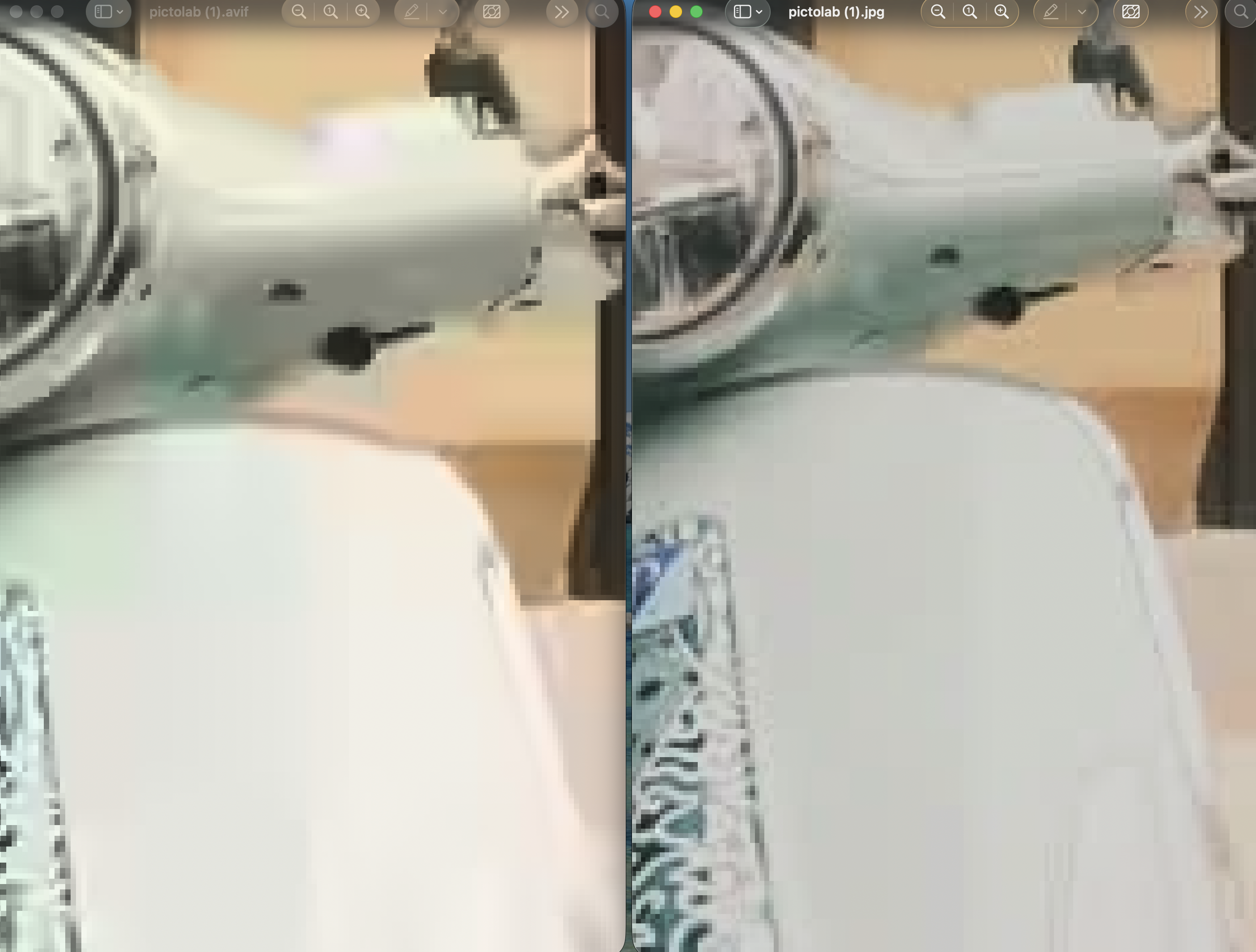
I was curious so I gave it a try and switched my photo editing site [0] to jpegli. Here's a comparison between a 29kb avif file (left) and a 146kb jpeg file (right), as produced by my site: https://files.catbox.moe/wdo9gf.png . The avif looks much better to my eye, and is of cource much smaller
Firefox is getting the flag to turn it on in the next release, chromium just added it back now there is a rust decoder. The wheels are turning again. Browser support for jpeg xl is very much in progress again.
Long term archival is often also about long term support and there just going with the most popular/supported ones might be a safer bet, eg in the extreme case if I wanted to save some digital photos in a time capsule I would likely choose PNG and JPEG
I have been using JXL for all my personal photos. My photo server Immich will just transcode a JPEG to display on devices which don't natively support JXL.
I think energy efficiency matters more with EVs, because it determines how frequently you have to charge on road trips, and more aerodynamic designs look a bit uglier.
Ferrari makes hypercars, they know a thing or two about making aerodynamics look good. It's a primary concern of all their designs and yet all their other designs look a lot better than this.
I think they are just falling into the same trap all other manufacturers do at first. They think the customer buying the EV is a different customer, who didn't like their other cars. So they make the techno-future mobile for a customer that doesn't exist.
Just make the same cars with an EV drivetrain, that's what the person who loves your brand but is in the market for an EV wants.
Legacy car manufacturers have done just that (forcing an EV into an ICE chassis). The results generally suck and the pure EV manufacturers like Tesla and BYD have kicked their ass in the market.
You can use a similar design to your existing fleet without a literal retrofit of an existing chassis to shoehorn a battery and electric drive train in there.
The retrofits usually are less preferable not only because of pointless inconveniences like transmission tunnels, but because they'll be the manufacturer's first toe dipped into the EV waters. The retrofit chassis speaks to either a rush to market, or a cautious approach not wanting to commit too many resources. The former says it'll have issues, the latter says they might bail on it and leave you stranded for service and repairs. Or both at once.
That was kinda different thing. It was legacy manufacturers scrambling to push out any EV they could get together so they are not left behind too much. But in meantime they started working on genuinely new designs (like Hyundai Ioniq, Mercedes EQS, BMW Neueu Klasse) or they adjusted their platforms to better accommodate electric drive trains (like Audi e-tron).
Aero efficiency means going faster and going for longer without making the battery heavier. The cost and packaging aspects of bigger batteries doesn’t matter to Ferrari, but speed & handling absolutely does, and weight is a definite speed/handling penalty.
Exactly! Many Ferraris of the past have gotten single digit MPG, no one cares. All of a sudden they have to make a Chinese looking EV because of "efficiency"? Give me a break.
One thing you can do with this that works quite well is use it to "decrop" (widen the viewing angle) of a video. This is very useful for stabilization which usually involves cropping. Here's an example: https://x.com/i/status/2051504427287404568
Once they get quicker to train, I expect this to be a popular use of them
It's tempting to blame any political outcome you don't like on lobbying. It allows you to believe that almost no one supports the outcome that you don't like, because you can blame it on politicians manage to be bought by a small number of lobbyists. But it might not be the case. Several states (I believe Texas, Georgia, and Indiana) don't charge sales tax to data centers. So from Louisiana's perspective, the alternative to the tax break might not be $3B in tax revenue, but $0 (as Meta would simply build elsewhere). I'm sure they still plan to collect income taxes for the temporary jobs created for the construction of the data center, and of the permanent jobs required to maintain it.
If states all worked together, they could plausibly prevent this race to the bottom by agreeing on a universal sales tax minimum, but there are many obstacles to that as well besides some vague sense of "lobbying". You'd want all states to work cooperate on their minimum tax, but every state has a big incentive to break from the cartel and offer lower taxes in exchange for getting all the datacenters built there. There are lobbyists who are working against this, but it's not just meta and google, it's also local utility companies and construction/trade unions (who all want their state to defect and be the one to get all the new money and jobs)
Well said: why does a tax break bother people so much? That feels pretty populist to me: data centers of this magnitude offer a ton of economic benefits to the area and the state, 3.3B in tax breaks are the price to pay to incentivize them to bring the business to the area, which will then provide a net positive financial benefit. I can see plenty of problems with data center construction that should definitely be addressed, but why do you think states offer such huge incentives?
But it's not less in local coffers. If the incentive was not given, the datacenter would not be built there. The state government wants it to be built there to increase economic activity in their state.
Residents aren't paying more for anything and no services are being cut.
There are 50 states in the US and plenty of other locations to build datacenters. "Still needing the datacenter" isn't a reason to build it in this specific location. It's ok to just admit you were wrong.
> There are 50 states in the US and plenty of other locations to build datacenters.
Yes, and we should ban them from issuing these sorts of race-to-the-bottom sweetheart deal at taxpayer expense to trillion dollar corporations to address that.
Long-term tax-breaks for something like a factory, which will ideally employ hundreds or thousands of people for a very long time? That can make sense. There's a lasting, local benefit, and that benefit can stand some encouragement. Real, local people will have real, local jobs. It can be good.
Datacenters aren't like that. There's a huge construction phase where billions of dollars get spent followed by dozens of long-term employees. The local benefit is mostly just a flash in a pan while the tax break lasts for decades.
Besides, it seems that datacenters are universally unliked by constituents in areas where they pop up. This makes arguments for tax breaks for datacenters seem illogical, at best.
Unilaterally, these favorable arguments come down to something like: "Well, if they didn't offer the tax break here, then Metazonaigoog will just build their new datacenter somewhere else instead!"
To which I can only retort: "Really? You promise? Don't threaten me with a good time -- go ahead and build it somewhere else."
>data centers of this magnitude offer a ton of economic benefits to the area and the state
I have only seen this point being brought up by the exact people that will be owning the data centers with little data to back it up besides temporary construction jobs and few long term jobs, most jobs likely imported and not local.
I think states are offering huge incentives because the politicians approving the construction and tax cuts are easily bought out for pennies on the dollar. I don't know if Louisiana is known for being a paragon of honest politicians doing right by their constituents.
I find it bothersome because the system incentivizes giant megacorp monopolies. If you are small you'll have to pay taxes like everyone else, but once you hit some threshold of huge enough, we'll let taxes slide so you can get another leg up. A datacenter this size isn't going to provide more economic benefit than 50 datacenters 1/50 the size, but only one of them gets special treatment.
Combine that with the fact that large corporations constantly find ways to avoid paying taxes and its hard to be positive about this kind of thing.
> Well said: why does a tax break bother people so much?
Several reasons. It distorts the market for one. One tax rate for me, another for thee. That's government picking favorites. Generally regarded as a bad thing.
I'll bite. What's the downside of a flat tax for a category like datacenters? If Meta want's to negotiate a lower tax rate for datacenters that's great, just allow every datacenter to apply for that same rate then.
Because its my money, paid to rich people, to make them richer. There's no obvious "net positive financial benefit" in many of these situations, and even if there was the impact they make is not just in financials, but in utility management, environmental management, etc - its not just a magic number go up.
If we all have a debt to pay and yours is wiped off the ledger for some bullshit so and my dollars have to stretch further to pay for something, you stole my money.
Providing tax breaks for construction that provides real, tangible benefits is one thing. Usually the argument is that a factory of some sort will provide long-term employment for residents.
What's the argument for a massive AI datacenter that employs very few people, strains infrastructure, and has the stated purpose of doing work that people had been doing, presumably reducing employment?
"If states all worked together, they could plausibly prevent this race to the bottom by agreeing on a universal sales tax minimum"
The states, under Trump, are all working together to ensure a race to the bottom happens, both in the U.S. and abroad.
One hundred and thirty five nations worked together to create a minimum corporate tax rate called "Pillar Two". It would have factored in tax breaks for projects like this by calculating an effective tax rate for Meta, and mandated higher taxes if the effective rate was too low. Trump withdrew the U.S. from that effort and created a framework to retaliate if other countries upheld Pillar Two to raise taxes on American megacorps[1] in their jurisdictions.
Well, now you see the issue. It only takes one hold-out for the plan to fail. The federal government could pass a law to at least ban it within the US, but the federal government can't seem to pass any laws right now.
It wouldn't be a problem if 1) people get a say in the matter and 2) those tax breaks don't require increasing taxes else where. So far with all the data centers built that does not seem to be the case.
The camera isn't the part doing that verification. The google service serving that "reCAPTCHA" is what's doing that validation. Unless you're using a custom browser that is reporting a different domain to google than the one requesting the reCAPTCHA, google's service will know which domain is which.
It would be generated by some other website like Amazon. Because I own, say, Meta, I copy these Amazon-generated codes over to Meta, make people scan them on their phones to sign into Meta and then pass the solution back to Amazon so my bots can sign into Amazon.
We don't yet know how the client side works, perhaps there will be a decompilation posted soon.
It's possible this scenario is acceptable to them because it means they can still tie your access to something that's easier to ban without requiring a full account login.
What are you implying? That it will become ineffective due to that?
That's possible... and they might change their mind if so, we will see.
I feel like it's a similar issue to when scrapers pretend to be an allowed-origin webpage in order to abuse "public" API keys for web services.
They could also require the mobile device to interact with the requesting webpage in some manner, similar to mutual PIN/codes for Bluetooth/TV pairing these days. That way bulk sharing of the codes would still require active participation from the device that requested it in the first place, likely with a short time limit.


The price at IPO will obviously be influenced by expectations of a future purchase by index funds... as an analogy, if it became public knowledge that next week, 1,000,000 people would all be required to buy gold, the price of gold would go up today, not next week
reply