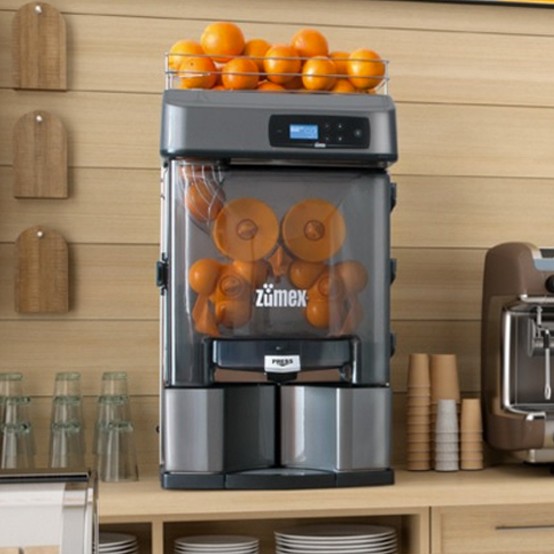
A local grocery store used to make their own fresh squeezed using a refrigerator sized stainless steel machine that might as well have been a Rube Goldberg machine with its winding metal wire chute full of oranges which led to the squeezing head. That thing was kept right in the aisle next to the refrigerator case they kept the juice in. It was the best orange juice though expensive as it was over 10 bucks a quart when the store finally closed. I tried to call and buy the machine but got nowhere. Turns out the owner died so the family closed up the shop and liquidated it.
As for Minute Maid, it has always tasted awful to me and it tasted worse in the 80s. The only packaged OJ I can stand is Tropicana.
Or you can buy a citrus juicer and make it yourself. A couple or three oranges and a few seconds in the morning.
OXO Good Grips runs about $20, it's a squeeze-by-hand option. You can get a wooden reamer, or spend about or upwards of a Franklin for something complicated, though I find simpler is saner.
I have both an old school glass dish reamer as well as a wooden reamer. Use it for making lemon/lime iced tea (using actual tea, not that powered sugar crap) for the summer months.
pretty much everywhere in the Netherlands has contraptions like this, small though, not fridge sized. Didn't see orange concentrate anywhere.
Minute maid actually tastes better than Tropicana to me (can't stand that brand), been getting one from Spain lately at Costco (Don Simon) that's pretty good, less sweet.
I have never liked Tropicana or Minute Maid, but about... 30 years ago? We used to have a brand called Fruvita that actually tasted good but it got bought by Tropicana, the taste changed, and we just stopped buying orange juice.
A Sam's Club in my area has started selling fresh squeezed orange juice. It's quite delicious. (And yes, it's pricey.) I've looked around at many other stores (including places like Whole Foods) and nobody else seems to be doing this.
> Soon after, the Model 3 began throwing service warnings and appearing to tighten up its behavior. Evans openly worried that Tesla might effectively blacklist the car once it realized how much of it had been stripped away.
Skimmed this slop and it does not say anywhere that it was "shut down." He got some warnings and "openly worried." That's it. Nothing else is said. Boo.
> However, the tech exists for a reason and is not inherently bad, the issue is the lock-in, the lack of choice and interoperability.
These low-tech tractors could become a hot bed for open source experimentation. Nothing stopping someone from sticking a tablet on the dash. You could run GPS harvesting optimization software or some webthing locally. Could be cloud or clever DiY farmers could run their farm off a local instance on a small machine using a WiFi AP atop the barn or whatever.
This was my take as well. How many 3rd parties might be able to bring on upgrades/modifications to a "dumb" tractor to make it smart vs only being able to buy a "smart" tractor from one vendor and be forced into it's rules/restrictions/prices
But there's more to agtech than driving a tractor around, a lot of what these big integrated systems do (at the high end) is very data driven -- determining where and how to plant, irrigate, fertilize, etc. There's a lot of integration work beyond just making the tractor drive.
35 years in the tech industry has taught me one thing: incumbents that have been around for a long time are almost always more clueless and more full of shit than you think, what they do isn't as hard as they claim and you can probably do better given a fraction of the time they spent just because you don't have legacy systems to worry about and because technology and tooling has moved on.
Incumbents thrive on the myths about what they do being hard and impossible to replicate.
Yes, it is a lot of work to replace what you can get off the shelf today. But it isn't like the basic tech itself is all that hard to replicate step by step if you accept that it takes time and the first N development stages will give you something that isn't as feature rich and polished. And if one makes it open source, interoperability will be easier to do something about.
Perhaps some of the analysis tools/services you can buy today will be hard to replicate, but I doubt they are that hard to replicate. And it is worth having slightly suboptimal results for a couple of seasons than being on the receiving end of a hostage-situation.
But yes, it is certainly a huge effort to get what you actually need.
The Pareto principle applies. For highly complex systems it’s easy to build most of what the incumbents have. It’s the last 20% where it is hard to catch up just because the incumbents have decades of a head start and have the momentum. And even more so here because it’s not just software. It’s very science and hardware heavy.
For farming, it’s even more tough because the market has a really uneven distribution. Usually the best place to tackle huge incumbents is in the midmarket. They’re big enough to need your automation, but they’re small enough to take a risk to save some money, and the features you haven’t built yet aren’t blockers for them.
But there’s basically no midmarket farming, all farms are pretty much either really big or really small.
> But there's more to agtech than driving a tractor around, a lot of what these big integrated systems do (at the high end) is very data driven -- determining where and how to plant, irrigate, fertilize, etc.
How difficult is this to implement outside of big ag-tech? I feel that a community of experienced farmers and programmers (or programmer-farmers) could tackle this.
The machine, from tractor to combine and everything in between often feeds data together to produce a holistic understanding.
Things like
- How much fuel was used
- Where your tractors and sprayers drove
- Soil samples and content
- How and where every bit of chemical and fertilizer was applied
- What weather hit your field
- How much and and the moisture content of every bit of the field you harvested
But if you're observing a fleet of 100+ machines you kinda need some integration and a central location. Which in turn connects to multiple other services like weather, crop markets, fuel prices etc.
I think that is a different market than the market for dumb tractors. There might be some overlap, but I doubt the people who want to fix their own tractors are different than the corporations that are tracking 100 tractors across hundreds/thousands of fields.
The software is certainly easier to build, but there's a lot of hardware involved here beyond the tractor. Claude is not necessarily going to make it easier to do soil sampling or measuring field conditions or yield outputs.
Farmers would be foolish to rely on an LLM because farming margins are too low to makeup for even a small quick mistake. Many farms will profit 1% on investment over 1-2 decades, although year to year yield can vary 30%.
What kind of sensors do those cheap kits come with?
A tractor is a big thing to have rolling around unsupervised. I would want a lot of safeguards. Blindly going from one GPS point to another sounds like a nightmare.
The cheapie aliexpress specials simply drive the line they're programmed to drive. They have GPS and a gyro to account for the slope of the land. You're supposed to stay in the tractor while they're operating as a safety... but this doesn't always happen in some parts of the world.
30 years ago you had a hand-gas and clamped the wheel to drive the tractor in a line. Using GPS is a litle bit more safe than that. And I talk about Germany!
Right, but that has nothing to do with a vendor making a dumb tractor. Why do we need to dismissively move the conversation from TFA. The data driven approach is made up of several parts, and we're looking at a specific part
Making a dumb tractor for the use-case of dumb tractor is obviously a winning idea.
I just don't think you're going to effectively compete with big agtech by putting a bunch of parts in a box, shaking it, and hoping you end up with a beautifully integrated solution. Integration hell is the reason big commercial firms dominate when it comes to large integrated systems.
Why not? They sell telematics systems separately from cars. It’s possible to do this and it might not be too difficult depending on how the system is composed.
Precision ag is orders of magnitude more complicated of a system than vehicle telematics. Again, driving the tractor is the easy part, and you can already get cheap systems to do this.
admittedly, i'm not a farmer nor an expert in data driving farming. but getting a farmer the ability to precisely drive a tractor in a field so that planting seeds, applying fertilizer, and any of the other steps would be a huge win. The settings used when doing that can easily come from bigFarmData gained from other sources. Can it be used even more precisely when everything is gathered/integrated by one company? That's a question that I'm not by default saying yes to, but it seems like you do think that is true. Even if it is true, does that mean the difference from a farmer going broke because his DIY tractor behaved slightly differently than your solution? I'd posit that a farmer only being allowed to play the bigFarmData game by only being allowed to buy from one vendor that is expensive while also forcing any repairs to be expensive will cause farmers to financially unnecessarily struggle.
The economics of farming (at least in the US) are brutal. Scaling up is really the only way to make a living long term. Some of this is due to equipment cost (look up how much a combine costs), and some is due to competition. It's not unusual for a farmer to be land rich and cash poor.
If you want to see a couple of guys learning how to farm from scratch, visit https://www.youtube.com/@spencerhilbert. Spencer and his brother made a bit of money off games and Youtube and have been starting out on corn, hay, as well as raising beef. It gives a pretty good insight into how pervasive tech is in farming, and how despite that, how much of farming still relies on hard, physical work.
I'll check out Spencer's channel. For a comedy perspective, there's Clarkson's Farm or Growing Belushi. Even though they are for entertainment, there's a still a lot of info in those shows to not be written off.
However, I'm not as interested in being a farmer at that level. I'm much more interested in the homesteading aspect of farming. I'm not trying to feed the world as much as me and mine and maybe some extra. So not just farming, but also some ranching with sheep/goats/chickens/pigs. I have friends doing this that I'm keeping an eye on. They had a head start as their kids grew up in FFA and are already familiar with raising live stock, and then having them processed to make that part much less daunting.
That would be a correct interpretation. Depending on how "cowboy" you want to go, there's plenty of slang. Raising hamburgers and steaks. Bacon seeds. Lamb chops. Just idiomatic sayings referring to the ultimate end products. I've heard all sorts of things to be cute.
Scale is a huge factor. It makes the most sense to invest in precision ag tech when you have enough acres that the investment pays off. At 5000+ acres, farms are using integrated systems that combine satellite data, on-tractor sensors, soil sensors, drone sensors, in-field weather sensors, with a lot of science to squeeze the most out of the land. At that scale, there's a lot of money invested in a season and you aren't looking for a DIY project, you need production quality product with proven scientific rigor. You probably don't have the manpower to do a DIY project anyway, you are relying heavily on automation and outsourcing. And at the low end, it it more effort to implement any of this than you'll get out of it.
So a DIY solution is aiming for somewhere in the center of the market -- enough scale that it makes sense to bother, but not enough enough money to avoid the headache of DIY. It might make sense for some mid-sized farms in developing economies, but it seems to be a narrow window to me.
Is suspect most farmers would prefer the diy add-on version of these than the single manufacturer integrated one. A modern smartphone and stay of I/o sensors send like it could do pretty much the entire job
I had to scroll back up to see what this reply was to, to get the full chuckle and yup, I was told frequently by my male parental unit that the top two reasons for having kids was chores and tax deductions. But there's a reason farm families leaned on the large side. The more hands you had helping the less hard things could be while never being easy
Years ago, there was a TED Talk[0] from the guy that started Open Source Ecology[1]. The TED Talk was really cool, but I haven't really followed what they did. It sounded promising to have open-source technology for use in this space.
I absolutely love this vision. He's still working towards the goal. It seems that his vision has problems scaling up though. He seems to mostly still drive this himself.
They have no driving electronics, electronic throttle, ECU controlled injection etc, so you are limited, you can't for example easily make it go constant set speed, because the throttle isn't electronic.
It went a bit too far, optimum would be modern enough to have drive by wire but with open ECU and documentation
You can still control a completely mechanical engine to work with set speeds. There are mechanical governors that can do this, or you can get an electronic component that moves the throttle for you. Fixed speed engines with variable load are much older than the transistor.
It is no harder than doing it with an ECU, except that you need to install a servo or speed governor with hand tools, instead of fiddling with ECU code.
From a software perspective it’s the same. The software doesn’t care if it is telling a servo to rotate or an ECU to increase speed. Both systems need an external speed sensor feeding in. The only extra on the mechanical engine is adding a generic servo.
Both systems can use an open bus protocol. The mechanical system resists proprietary rent seeking as an added bonus.
We’re commenting on an article about farmers willing to pay for tractors with rebuilt all mechanical engines when the exact same tractor could be built with a new computer controlled one. That choice was intentional.
It has a governor.. The P pump 12 valves (and many other multi-application diesels) come with either one of two different governors, an automotive one which has a high idle and low idle, but unrestricted fueling in between. This is what you want in a car or truck where you're controlling road speed with your foot. There's also the "industrial" governor that essentially maps lever input linearly to engine RPM, and endeavors to maintain its set RPM independent of load. This is the kind you find in tractors, generators, boats, etc.
These governors are basically mechanical analog computers which use the inertia of flyweights, springs, and some very clever linkages to do their thing.
There's a device called an "aneroid compensator" that sits on top of the governor and is used to maintain a fueling profile for a specific density altitude (e.g. limit fuel at higher altitudes on naturally aspirated engines or off-boost on turbocharged engines). This effectively maintains AFR, although it is not a closed loop system. For closed loop control you need to measure AFR directly in the exhaust and compensate, which means you need (at least, a common rail system that can time injection events independently from the valve train would be even better) an electronically governed injection pump. There's no good way to do this with some 3rd party add-on. You'd be much better off just using an electronically governed Bosch injection pump (like those found on 24 valve Cummins or 1998-1999 Mercedes OM606 turbodiesels). But then you incur the encumbrance of the ECU and all the bad corporate behavior that comes along for the ride.
Also note that maintaining a particular AFR in a diesel is kind of a non goal, at least from the perspective of engine performance. With the older style, simple injection systems that are user serviceable you only get one pulse per cycle. So you can't really change AFR without compromising torque output. For a tractor, when I set the lever all the way forward I (the operator) expect it to maintain revs sufficient to maintain 540rpm at the PTO unless it is not able to do so (fueling maxed out under load). Putting more load necessarily means more fuel in for a given RPM, ergo higher AFR. Note that turbocharging changes this equation a little.
There are already open source auto pilot and cruise control implementations for cars. (Not all cars are supported obviously!) so to have this in place for tractors off the road seems very doable.
I would be surprised if this doesn't exist already in some nascent form?
This is an area where you would probably need entire ecosystem of systems that are onboard tractors, but also for the various implements you hook up to it to monitor sowing, fertilizing, spraying etc. Including backend systems that you can either self-host or subscribe to some service that doesn't have awful terms.
It shouldn't take immense amount of capital to make some real progress towards something that can make a difference.
Well open source AutoSteer exists it has a lot of features like rate control built in to it. The system is called AgOpenGPS it’s very popular for retrofitting older equipment with modern technology.
My bet would be there will be a niche for these tractors at hobby farms but the reality is outside of niche goods and hobby farms, farming is about scale and the machines that companies like JD sell help a lot. Sure the tech is locked down but at the scale those players are running at it’s baked into the service contract to minimize downtime.
Right those are niches like hobby farms. There is a market but it has a pretty distinct shape. The broader point was a machine like this is not changing farming.
The beauty here is even beyond experimentation the tech will change repeatedly over the life of the equipment, and you can cheaply adapt to that. There is very little advantage to the modern tractors, beyond luxuries and the finish of a self contained package. Farmers rarely ime prioritize either of these
With high end tractors you can have them drive themselves on the rows based on a GPS map that was created when you planted. That's going to be difficult to retrofit.
I have an el cheapo 120 VAC 3600W import inverter with just two 100AH AGM batteries in series as it's a 24 VDC unit. Right now its all temporary and more experiment than practical.
Inverter mounted to a portable frame I built from bolted slotted angle with two battery shelves for a total of 4 batteries (only 2 now.) The batteries have a 200A terminal fuse and run through a 200A disconnect to the inverter using #2 AWG cable. The inverter, AC input, AC output are all grounded to a single ground bar that is bonded to the metal frame. AC Input is fed from a 12 AWG cord with 15A plug. AC output runs two 15A MCCB's, each terminated to a single socket hanging off a short whip cord. A cheap two wire digital DC volt meter is wired in series with a push button so I can see the battery voltage at a glance when I have the inverter powered down.
I temporarily setup the panels in my yard as an experiment but since I am in the city, I don't get good sun in my yard with all the obstructions. Honestly I ran it for two days, took the panels down before it rained, and didn't get a chance to measure anything. The panels really need to go on the roof and I have no intention of doing that any time soon.
The system did come in handy as a backup for my boiler when a wind storm knocked the power out for an hour and a half this past winter. I have thought about setting it up as a UPS for my little IT setup at home but 3600W is super overkill.
All of my system, aside from batteries, is Victron and installed in a small lean-to. Batteries are 8 x Fogstar 48V 100AH, in an outdoor rack, since I have no dry space indoors for batteries.
While I realize LiFe batteries are quite safe, at the time I bought this setup I felt more familiar with AGM so I went that route. The prices were also comparable and I can use these in a truck project I also have.
This happened to me so I emailed hn and got a response that stated that at one point I had a cluster of down-votes for bad behavior and since that period had no issues so they lifted the ban. Simple.
I think it feels a little bit of an Ad for the hardware, especially the way he describes the case, telling you the exact model and how spacious it is. Bit sus but perhaps he is being OVERLY detailed and just likes telling you he has a bunch of CPU's that are well cooled in a case with two big ugly fans on the front (not into that look at all.)
Though I can totally understand, geeky people love details. I have a habit of getting way too detailed in my writings here. So I then spend most of the time editing it down to be as clear and brief as possible. I refuse to use an LLM for my own thoughts.
> Wow. Tech CEOs and investors have completely lost touch with what money really is worth.
Remember those stories of lottery winners who win millions then wind up broke AF, even homeless, in only a year or two because they have no impulse control and blew through it? Same people.
Since none of them are actual migraines, most advice was the standard: drink more water, get enough sleep, are you stressed at work, etc.
I won't move back to my hometown because of it and it hasn't been as much of a problem. My grandmother said that I had a distant cousin who would get sick whenever he came to our hometown from Chicago as well. Said that his doctor thought it might have to do with the swampy air around the area. Pee Dee region of South Carolina, where Francis "Swamp Fox" Marion operated during the Revolutionary War.
The next level of this is serving the Arduino as files: https://github.com/echoline/NinePea then mounting that on your host OS. A friend wrote his own 9P server while doing embedded work on an ST Arm board by mounting the board under Linux. Files are just nodes to RPC calls that you the user decide so the file server can do anything.
Your IO points can be individual files so you can 'echo 127 >/n/arduino/pwm0' to set and reading is just as easy 'cat /n/arduino/pwm0' If you want to save all the pin states you 'tar -c /n/arduino | gzip >arduinostate.tgz' then reverse that process to write the values back.
To change pin config you can create a ctl file which you can use to control and configure things using key=value pairs, e.g. echo 'pinmode pin=3 mode=output' >/n/arduino/ctl. Errors are communicated through the file system so a failed write() will return -1 along with an errstr(2) message to your calling process.
Want a cli in addition? No problem, just make a file called e.g. con (console) and hang a REPL off it. Now open that file using a console emulator like con(1) on Plan 9: 'con -C /n/arduino/con' and type your heart away.
I have toyed with the linked library on 9front and tinkered with robotfs and the RNG demos. This is one of the cleanest ways to interact with software IMO.
No, which is a good thing. As demonstrated, things like -z are completely unnecessary. If you want to save time typing, you write a script. IMO things like -z are hacks people thought were clever because it saves THEM time typing without thinking of WHY it was not there in the first place. Pipes and shell scripts exist for a reason.
> The only problem was most cashiers actually knew all the prices of stuff and paid attention,
Yup. I was in a local super market and saw Tomahawk steaks priced at $4-6 each. It had to be a mistake but I figured I would give it shot and see if they noticed. Cashier looked at the price, did a confused double take and immediately called over the manager. Turns out the decimal point was off by one so my $4.50 tomahawk was really $45. I bought it anyway and it came out great in the oven.
Did you pay the sticker price or the intended price?
Over here in Poland we have a law that the store must sell you the good for the price it advertised, so in that case they'd be forced to accept $4.50 because of their mistake. May sound too biased in favor of the customer, but before that, the "errors" in price tags were more common.
We have similar rules in the US, but depends on your state. In mine they have to give you the price on at least one of the items but you can't demand they give you 100 of them at the wrong price. Or yes you can demand but they are not required to do so.


As for Minute Maid, it has always tasted awful to me and it tasted worse in the 80s. The only packaged OJ I can stand is Tropicana.
reply