I've been seeing WP's failings more and more, especially as Gutenberg keeps adding kitchen sink features to stay cool and trendy. The static site builder is on my todo list.
The email list was a plugin on WordPress. I had to grieve the loss, but I'm better now from it. Anyone who cares enough can get an RSS reader, which I've realized advances my techno-political values on software freedom.
I'm happy to pay more for web hosting, and that's basically what I did when I migrated. It's not that I'm over-using resources.
I didn't start in web development, and have only adopted paying for on-rails hosting as a reluctant desire to meet my essay-making purposes.
As far as being a "thought leader" in any sense of the word, I'm really not important: just an essay hobbyist with lots of static content. 2-4 of those essays are controversial, but most of them are useful-but-nonconfrontational crap like how to cook well or how to navigate bureaucracy.
In some ways, I represent the ideal shared hosting customer: Very little web exposure, minimal-to-little SEO, paying customer.
My opinion is that it was likely a confluence of factors that piled up at once. It's not uncommon for things to work steadily, until they don't. I'm clinging hard to Hanlon's Razor on this one.
Thank you, that's what I needed. I regularly update content to a list on Big Tech's unique perturbations[0], but I need to remember Hanlon's Razor.
That harbinger of hardship is also why I've been dialing back my career aspirations. I learned from personal experience around 2010 that rough economies create the following pattern:
1. A significant proportion of highly qualified people with 5 years' experience at [skill] are laid off.
2. They have to settle at seeking roles that require 3 years of [skill].
3. The 3-year experienced [skill] workers have to settle for 1-year roles.
4. Recurse for 1-year roles for no-experience roles.
5. New [skill] workers can't start in the market unless they personally know somebody.
Generally, SEO is an opaque algorithm designed to prioritize content that is most likely to add meaning to users (therefore increasing their own importance) or advance an agenda (therefore benefiting the organization).
Unfortunately, the internet has devolved in the past few decades from a repository of variously-inclined content builders into a comparatively fewer set of monolithic semi-walled gardens.
To that end, SEO requires an ever-increasingly complex set of trivia regarding a few aspects:
1. The social media networks most likely to favor outbound links to your domain (pro tip: they all favor inbound links to their domain, then typically domains of other monolithic semi-walled gardens).
2. The means to gain traction in each of those semi-walled gardens, which varies heavily by domain, but effective distills to stuffing the magical set of keywords and hashtags at the correct timing.
3. The precise set of keywords on the site itself. They must strike a delicate balance between creating an easy x-ref to their social media presence, but also human-readable enough that people will navigate through a few pages (and therefore not adversely hurt the bounce rate).
I'm absolutely sure I'm missing a few details, but that's the general gist of the SEO business from my own deep dives.
AI has magnified the use cases, though. Before, Big Data was an advertising machine meant to tokenize and market to every living being on the planet. Now, machine learning can create "averaged" behavior of just about anything, given enough data and specificity.
Full disclaimer: I'm an industry amateur, went with the WWOOF program for 6 months, have kicked around what it'd take to make a living in agribusiness, and live in Iowa where the farm reports are on the level of celebrity gossip.
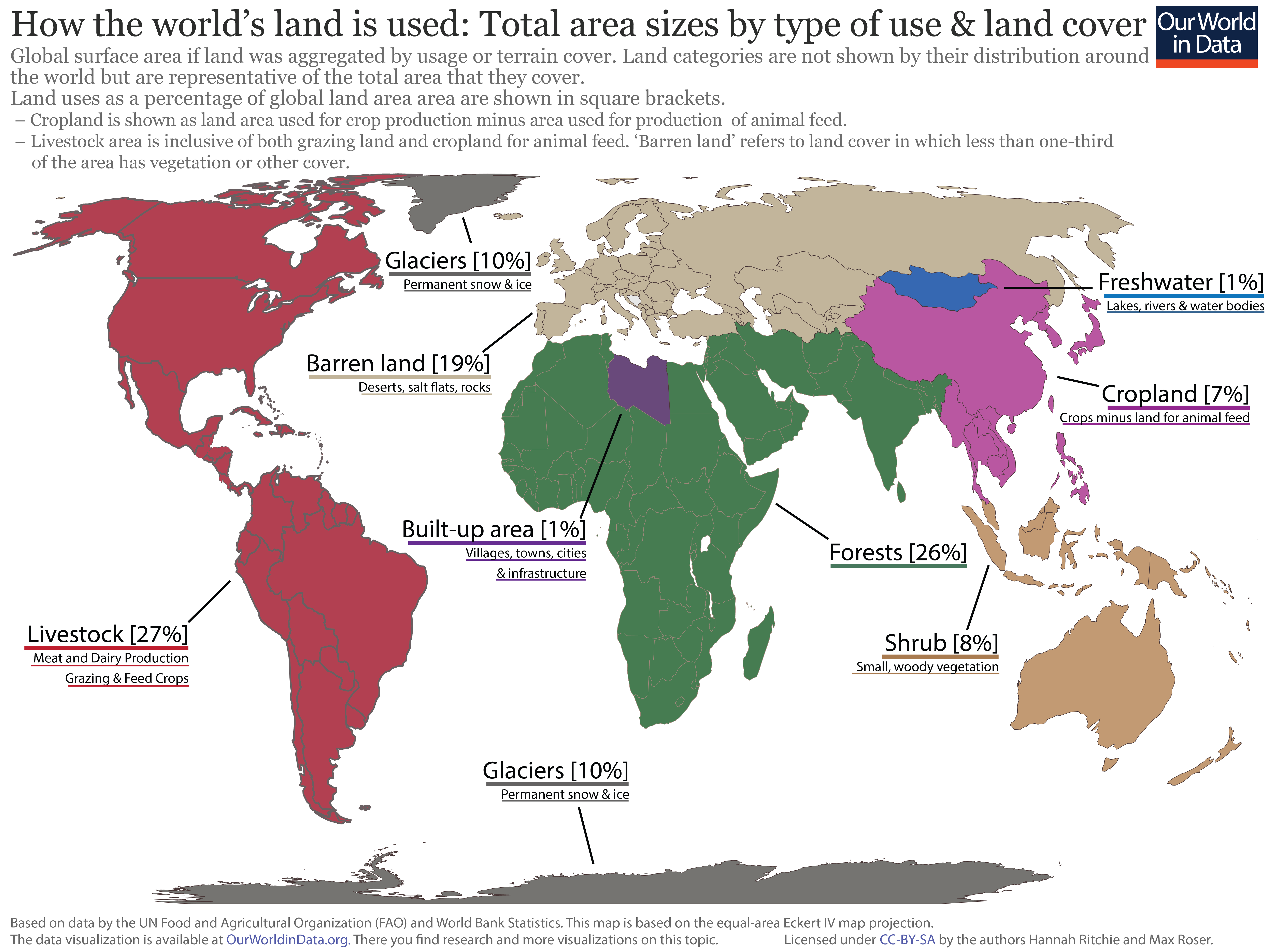
The trouble with biodiversity isn't about lower yield-per-acre, but more that it's not the most affordably scalable. It's not hard to set up and configure planting a homogeneous crop across a vast range of acreage, then hit each stage of the process (fertilizing, weed-killing, harvesting) with vastly powerful equipment in what's effectively an array. It takes more work to create an interdependent system that uses nature to fix nature, but many communities have done it for centuries (e.g., the Mennonites).
The one risk of scaling is that it's a short-term gain with a specific technical debt with the soil: too many repeat seasons of the same monoculture will create weaker yields from the decreased essential minerals for that specific plant. There are a host of existing solutions to this, with varying degrees of implementation and effectiveness:
1. Plant different monocultures in that location each year, though this isn't so useful if the entire region is configured for a particular plant. Iowa may be better for corn and Kansas for wheat, for example, meaning the market yield will be diminished for functionally the same product.
2. Employ the ancient method of "letting it rest" by not planting it every 7th year or so. Cuts back on profits, but lets the land heal from simple non-use (e.g., bugs and birds do their thing). The article implies this one, but with strips of rainforest in the middle of the acreage.
3. Rotational farming with grass seed and ruminants. Roaming cattle are literally the answer to climate stability, for multiple reasons.
As it stands, farming at scale works that way because it's been the cheapest way to get the most crops. There are only several ways to improve food availability:
1. selective breeding and (now) gene-splicing, which makes the food more resistant to damage, larger, sweeter, etc. at the cost of quality
2. government incentives for "good old-fashioned non-GMO
organic produce", since most people will not pay an additional $1/lb for apples
The trouble with the article is that it abides by what I call the "Fragile Earth Theory", which posits that any aberrant act by humanity could send the entire planet into a downward spiral that renders us all extinct. There's enough scientific evidence to disprove that idea, but it's not politically fashionable to argue it and not the hill I want to die on. The article is interesting regarding biodiversity, but food security is now more a political issue than a yield issue.
> 3. Rotational farming with grass seed and ruminants. Roaming cattle are literally the answer to climate stability, for multiple reasons.
Source please. I've only seen Big Meat selling this point before and all info i've read on it points to it being very false.
The one guy who has famously promoted this idea also killed 40,000 elephants in Africa [0] to learn that he was wrong so i'm not going to take his slightly updated idea that cows will fix it instead...
Would you prefer he double down and not admit the elephant slaughter was a mistake?
Ruminants are not "the answer" to climate stability, and big meat is as pernicious as big ag or big oil or anything else, but neither are ruminants the foundational problem Monbiot et al claim. Our industrial approach to animal agriculture (to all agriculture, or all industry, for that matter) is closer to the root of the problem. Even closer to the root, I would argue, is a general predilection to exploit resources for short term benefit instead of entering balanced, reciprocal partnerships with the land and our fellow species for long term success.
It's not roaming cattle...it's a mix of animals that contain cattle as in:
-some cattle
-some goats
-some pigs
-some chickens
Some solar farms already use goats in the USA to keep grass and weeds down...the group of animals together has some benefits as opposed to focusing on one group of animals alone....too long of an biology ecology lesson to put here...but you can go to your local land grant university ecology department and ask them to explain it to you as it is a fascinating subject and kissing cousin to why vertical farming never ever is sound from an investment money stand point.
‘It’s Pseudoscience’: George Monbiot Blasts Regenerative Grazing In Heated Debate
“So any story that says it’s good to be farming these livestock, it’s good to be eating these livestock, is a story which justifies among the most devastating processes on Earth,” he said. “It is climate science denial.”
Monbiot linked this denial to the interests of major corporations like McDonald’s, General Mills, JBS, and the Murdoch Network, who he says have “backed and weaponized” the idea that grazing cattle is environmentally beneficial. “The story is false,” he said. “When you make a grand claim such as this one, that livestock can mitigate climate change, either you produce the evidence for that claim or if you cannot produce the evidence you withdraw the claim. The evidence has not been produced, the claim does not stand.”
"A 2017 University of Oxford study titled Grazed and Confused accepted that managed grazing systems could sequester some carbon back into the soil. It added, however, that this was only around 20-60 percent of the emissions that the cattle produced in the first place. What’s more, after a few years soil reaches carbon equilibrium, meaning it cannot sequester any more."
"A review article published in the International Journal of Biodiversity highlighted that land left free from grazing had more biodiversity. “Published comparisons of grazed and ungrazed lands in the western US have found that rested sites have larger and more dense grasses, fewer weedy forbs and shrubs, higher biodiversity, higher productivity, less bare ground, and better water infiltration than nearby grazed sites,” it said."
"This report concludes that grass-fed livestock are not a climate solution. Grazing livestock are net contributors to the climate problem, as are all livestock. Rising animal production and consumption, whatever the farming system and animal type, is causing damaging greenhouse gas release and contributing to changes in land use.
'Ultimately, if high consuming individuals and countries want to do something positive for the climate, maintaining their current consumption levels but simply switching to grass-fed beef is not a solution. Eating less meat, of all types, is.’"
"So we should X?" is usually a signal that you're about to not track/engage with what someone said. I'm reminded of Cathy Newman's interview of Jordan Peterson where her only retort the whole time was "So you're saying that <something he didn't say>." (https://www.youtube.com/watch?v=aMcjxSThD54 -- A classic, even if you don't like the guy)
For example, they are talking about cows we farm into existence at the tune of 1.5 billion global population, not a few million wild animals.
No, I'm asking the commenter to consider the consequences of what they're saying. It is not "a few million wild animals"; there were an estimated 60 million bison in North America alone around 1800.
Why was it ok then but we can't have grazing animals now? I think the linked article makes a poor argument.
I'll take a stab even though I don't really have an overall opinion on the issue.
It was ok then because we weren't facing a climate crisis due to carbon cycle disruption then. Also, wild bison are different from domesticated cattle. One of the effects of the bison was shifting the boundaries between forest and grassland; now that they're gone more of the grassland is becoming forest, which IIRC captures less carbon than grassland. Also bison are native animals that might affect local ecosystems in many other different ways than our introduced cattle.
We've had an estimated 30-60 million bison in the US, now we have 100+ million cows.
And cattle and bison differ in their grazing behavior and ecological impact, making a direct environmental comparison unfair due to their distinct roles in shaping ecosystems.
It's our cattle and farming methods that are wiping out all wildlife.
The 2022 Living Planet Report found that vertebrate wildlife populations have plummeted by an average of almost 70% since 1970, with agriculture and fishing being the primary drivers of this decline.
* Of the 89.3 million head inventory, all cows and heifers that have calved totaled 38.3 million.
* There are 28.9 million beef cows in the United States as of Jan. 1, 2023, down 4% from last year.
* The number of milk cows in the United States increased to 9.40 million.
* U.S. calf crop was estimated at 34.5 million head, down 2% from 2021.
* All cattle on feed were at 14.2 million head, down 4% from 2022
As pointed out by olddustytrail .. that's the US.
Elsewhere meat consumption can save the planet by decreasing hoove heavy ferals that aren't managed at all - eg: Australia where camels, donkeys, goats, and cleanskin cattle are all introduced animals run wild that can be rounded up and trucked out every year in a never ending game of trying to keep their numbers in check and stop them over taxing the environment.
Kangaroos are native but savagely boom | bust - when the wet years hit numbers spike and if the population isn't culled the following years see the ground littered with dead as water resources contract.
> It's our cattle and farming methods that are wiping out all wildlife.
Well, when you say "our" you mean your own. Our local cattle graze on the machair.
But that's not the argument you originally made. You were saying it's impossible to raise grazing animals without being environmentally unfriendly. That is the part I dispute.
> it's impossible to raise grazing animals without being environmentally unfriendly. That is the part I dispute
Animal farming became unsustainable due to its massive environmental footprint, including deforestation, habitat destruction, pollution, and excessive resource consumption, which collectively strain the Earth's capacity to support such practices.
We cannot feed the population with the same version of American or European diets - we'd need 5+ Earths to do it.
"A 2017 University of Oxford study titled Grazed and Confused accepted that managed grazing systems could sequester some carbon back into the soil. It added, however, that this was only around 20-60 percent of the emissions that the cattle produced in the first place. What’s more, after a few years soil reaches carbon equilibrium, meaning it cannot sequester any more."
Feeding 10 billion people by 2050 within planetary limits may be achievable
A global shift towards healthy and more plant-based diets, halving food loss and waste, and improving farming practices and technologies are required to feed 10 billion people sustainably by 2050, a new study finds.
> The trouble with the article is that it abides by what I call the "Fragile Earth Theory", which posits that any aberrant act by humanity could send the entire planet into a downward spiral that renders us all extinct. There's enough scientific evidence to disprove that idea, but it's not politically fashionable to argue it and not the hill I want to die on.
Interesting take, living in a country that has created the Dust Bowl. If the "scientific evidence" conveniently forgets history in its back yard to prove whatever nonsensical point it is trying to make, maybe is is time to look elsewhere for meaningful insights.
There's a big difference between ruining a region and rendering everything on the planet extinct. Human activity depleting and permanently altering a local climate is well documented and known throughout history, but people move and survive. Nature is especially resilient and maybe with the exception of several thousand Megaton bombs glassing the planet (even then, plenty of microbes reside deep underground and might be radiation-resistant enough to handle it) life will find a way until Earth exits the habitable zone
Even in the current changes we're seeing, many regions will become uninhabitable (I'm thinking India, for example) but currently Northern cold-climates are expected to become not only habitable but support agriculture (1).
So yeah, we can destroy regions, but the planet lives on
In your experience, is it accurate that farming practices are a function of labour costs, and what is the time horizon where robotics changes the game for high density farming with diverse crops? There is a video about using machine vision and lasers for weeding, and I'm wondering whether we are close to full automation and don't need nearly as much land to generate higher yields.
Something like what these people do (shipping container farms) https://www.cropbox.co/ seems like we're really close to being able to run restaurants off them.
Why start on labor costs, and then end on land usage?
If healthy farming is limited by labor costs, the result of automation would hopefully be the pickup of healthy farming. The benefits going to quality of produce, long term soil sustainability, reduced usage of fertilizer and water, and other crucial benefits. Taking the advantage and focusing on land usage seems short-sighted to me.
You're definitely on the right track. Over here in Iowa, the dumb labor I've seen has almost exclusively moved to factories, with the full-automation tractors spacing out planting according to prior moisture and soil composition tests run over it by a prior-day tractor.
Micro-farming is definitely a hot thing, too. The plants are now getting smaller, but producing huge yields. Food sustainability in someone's suburban backyard is almost here, though I do believe it's a bit more fiddly than the standard old-fashioned greenhouse-then-transfer for personal farming that we've seen for a long time.
There's a business model waiting to happen for uninformed city-dwellers who want to get into the space, though it's more about selling education than a tangible product.
But, if you're creative and savvy in the biology/botany/ecology space (I'm not), I've seen all sorts of neat configurations. One of the most interesting organic farming techniques I heard of was a guy who had a fish pond on one side, which cycled water to the other side that had a hydroponics setup, meaning it was essentially a micro-ecosystem.
Yes, the planet will live on. But what we’re invested in is that it lives on to support ten billion humans demanding an ever increasing amount of resources per person.
It’s not particularly fragile (it’s gone through things much worse than humans in the past.) But the specific conditions of the Holocene that have been supporting us so nicely are a historical aberration. The ability to support so many people and their livestock (that latter part is not to be underestimated) is much more fragile.
Thank you, wasn't sure what it was called but have witnessed it quite a bit.
I don't have the sources, but we have hydrocarbon-consuming bacteria that eat oil and plastic (and have effectively cleaned up BP and Exxon-Valdez), as well as radiation-eating bacteria that live underground that have made Chernobyl almost habitable again. I'm sure there are other strange circumstances that arise that serve to "fix" defects within nature.
To add to that, completely removing 1 species from any habitat has repeatedly shown climate shifts, but rarely outright destruction of the biome. The only time that ever happens is when an entire class of species goes missing.
I don't mean to wax philosophical here, but the cosmological basis of belief has a lot to do with it. If the order that constitutes nature itself is the product of a complete random chance, we're one random permutation away from the stasis we're in. If any form of eminence defined this universe, however, we have room for error.
There are two Achilles heel of modern farming. One is that it's water intensive, which will come to a head real soon due to climate change.
The other is that it depends on mined and processed fertilizer a lot, especially for potassium and phosphorus. These can go down in availability due to various geopolitics. Nitrogen en masse is not free either.
Making these from scratch in large amounts literally requires fossil fuels, in particular syngas.
I'm not convinced those are legitimate problems, since we're great at detecting future problems but terrible at imagining future solutions. In the late 19th century for example, people were afraid NYC would cease to function because it'd be covered in pony poop.
Nitrogen exists in the air, meaning it's a question of filtering it. I've heard rumor of carbon capture devices, so yanking nitrogen out of the air seems trivial once someone gets the engineering down.
Water is mostly the same issue, with desalination being the final end to that scarcity. Before that, we'd likely be able to filter plenty of less-than-usable water for our plants' purposes, which may even include wicking it out of the air.
Not to say I know what the answer is, but that I know with absolute certitude that I don't know enough to project current geopolitical trends onto future circumstances.
The soil microbiome contributes to several ecosystem processes. It plays a key role in sustainable agriculture, horticulture and forestry. In contrast to the vast number of studies focusing on soil bacteria, the amount of research concerning soil fungal communities is limited. This is despite the fact that fungi play a crucial role in the cycling of matter and energy on Earth. Fungi constitute a significant part of the pathobiome of plants. Moreover, many of them are indispensable to plant health. This group includes mycorrhizal fungi, superparasites of pathogens, and generalists; they stabilize the soil mycobiome and play a key role in biogeochemical cycles. Several fungal species also contribute to soil bioremediation through their uptake of high amounts of contaminants from the environment. Moreover, fungal mycelia stretch below the ground like blood vessels in the human body, transferring water and nutrients to and from various plants.
Soil microbiomes drive key functions in agroecosystems, determining soil fertility, crop productivity and stress tolerance. ... System-level agricultural management practices can induce structural alterations to the soil, thereby changing the microbial processes occurring at the microscale. These changes have large-scale consequences, such as soil erosion, reduced soil fertility and increased greenhouse gas emissions.
You have the right to believe in the climatologists' consensus, but I'm not convinced. I still haven't heard any sensible answers to the common-sense claims I've heard about how water is a better indicator of climate change than carbon.
Lies become consensus proportionally to their political advantage, and the fact that climate science defines sweeping portions of government policy leaves me estimating that the fudge rate is above standard acceptable parameters.
Consensus is about the most anti-scientific disposition possible, by my estimation, and I'd like to hear discussions from a more diverse range of viewpoints than the stock-standard atheist humanist materialist naturalist POV that colleges tend to churn out.
> climate science defines sweeping portions of government policy leaves me estimating that the fudge rate is above standard acceptable parameters
Politics has not yet started taking climate change and overshoot seriously. I won't comment further on the matter.
> Consensus is about the most anti-scientific disposition possible, by my estimation, and I'd like to hear discussions from a more diverse range of viewpoints than the stock-standard atheist humanist materialist naturalist POV that colleges tend to churn out
Ah, consensus, the ultimate boogeyman of free thought, right? Because clearly, when a majority of experts in a field agree on something based on, you know, data and years of rigorous study, they must be shackled by groupthink. God forbid they reach a similar conclusion through independent research and critical analysis. No, let's ignore decades—or even centuries—of academic advancement in favor of "a more diverse range of viewpoints," irrespective of their empirical validity. After all, who needs peer-reviewed evidence when you've got opinions?
And let's not even get started on the "stock-standard atheist humanist materialist naturalist POV." It's almost like educational institutions aim to base their teachings on reason, empiricism, and the scientific method rather than catering to every fringe ideology that claims to have found 'The Truth™.' The audacity!
But hey, if you're not a fan of consensus, I've got some "alternative viewpoints" on gravity and heliocentrism you might be interested in. Why let overwhelming agreement among experts ruin a good debate, am I right?
Honest question: are there any aspects of climate science that aren't political these days?
I'd certainly love to see climate discussions that openly talk about facts, but it always seems to wind down to the Horrific Apocalypse Mitigators vs. the Crusaders Against Government Overreach.
You're probably right. From my vantage point (in an independent agent insurance office right now), the easiest way to shrink UW is to make it ALL run by independent workers (e.g., agents).
The irony of this, though, is that the quality of the underwriting risk assessment can suffer, meaning premiums will often be underpaid relative to statistical risk, and create more problems if enough of them push through.
Another money-saving trick I know of in insurance is to severely downsize the claims department. It's lawfully mandatory to process claims, but I'm not sure if there's a statute on how long to process them. One of the carriers my office hates working with can take 3-6 months to process a claim, and often will find some reason or another to not pay it.
If anyone wants a pain point, the insurance industry desperately needs a decent-quality rater/AMS: the tech and UX is hilariously ancient.
> Another money-saving trick I know of in insurance is to severely downsize the claims department. It's lawfully mandatory to process claims, but I'm not sure if there's a statute on how long to process them.
P&C companies have mandatory requirements for how long it takes to handle claims. During catastrophic events, those timelines are usually extended: because it can be dangerous and there are lots of claims.
Adjusters want to get paid and they don't get paid until the claim gets closed. So it behooves them to work quickly.
Do insurance policies get packaged and sold as financial products, or are they re-insured on the backend but continue to be held by the originator?
Related, at what point of policy origination/reinsurance are standards audited and applied? I.e. if I originate a mispriced policy, where does that get noticed/rejected?
> Do insurance policies get packaged and sold as financial products, or are they re-insured on the backend but continue to be held by the originator?
I've never seen this happen. Smaller carriers carry re-insurance since most smaller carriers are limited geographically and it's entirely possible a big-enough event would cause an issue where they couldn't pay out to cover all claims. State-based carriers (smaller farm mutuals, for instance) could be VERY susceptible to this.
In Texas after Hurricane Ike this caused a slew of changes to our underwriting guidelines along along the coast with rate changes and where we focused on recruiting agents and policies. (e.g. recruiting further north and west).
> Related, at what point of policy origination/reinsurance are standards audited and applied? where does that get noticed/rejected?
A lot of policies are bound for 30 days initially and then can be cancelled if the underwriting guidelines fail for the policy. Some companies may not even bind coverage until after underwriting is completed. As an agent if you sell a policy that isn't priced correctly, MOST of the time it gets caught by underwriting. They have ranges of limits that you can go between. For instance, normally contents coverage on a house can be some percentage of the insurance home value (let's say 40% to 120%). Let's say your house is insured for $250k... but you bought a $120k brand piano. Normal contents coverage might be 80% = $200k for your clothes, computers, electronics, kitchen stuff, etc, etc. That piano would require you to either 1) exceed 120% (which would require EXPLICIT underwriting approval) or you'd have to get a rider/endorsement for a special item. (which would likely also require more underwriting approval.)
I have my own essay that tries to summarize it[1], but the entire idea of insurance is to work with pure risk:
- Speculative risk is when you might gain from big events (e.g., VC)
- Pure risk is when you will only lose from big events.
The entire job of an insurance company is straightforward: take a little bit of premium calculated by actuarial data (historically represented as a table), then pay out large checks to the people who have an unlikely event.
I have a prevailing axiom that 3-10% of the population makes it difficult for the rest of us, and insurance gets complicated for that reason:
- people lie about claim damages
- claims adjusters sometimes find legal ways to not pay claims
- actuarial/legal framing can allow non-coverage of something that ought to be covered in good faith (e.g., driving your car out-of-state)
Now, that's the POV of the insurance company, which sets some context I wish I had had.
The POV of the party seeking insurance is that they're transferring pure risk, then paying rent to the insurer for it. It's possible to recurse this, and an insurer can become the insured by packaging up a bunch of risks and hand it off to other insurers for a price. I'm not THAT knowledgeable, but it wouldn't surprise me if that's what insurance orgs that took on too much risk actually do relatively often when they got a bit ambitious.
The tech world could actually learn a thing or two additionally from insurance. The secret to a functional insurance company with a liquidity issue is to, effectively, do nothing and wait for customers' insurance premiums to replenish the money supply. "Do nothing" is the exact opposite mantra of "Move fast and break things", and there's a time/place for both!


The email list was a plugin on WordPress. I had to grieve the loss, but I'm better now from it. Anyone who cares enough can get an RSS reader, which I've realized advances my techno-political values on software freedom.
I'm happy to pay more for web hosting, and that's basically what I did when I migrated. It's not that I'm over-using resources.
I didn't start in web development, and have only adopted paying for on-rails hosting as a reluctant desire to meet my essay-making purposes.
As far as being a "thought leader" in any sense of the word, I'm really not important: just an essay hobbyist with lots of static content. 2-4 of those essays are controversial, but most of them are useful-but-nonconfrontational crap like how to cook well or how to navigate bureaucracy.
In some ways, I represent the ideal shared hosting customer: Very little web exposure, minimal-to-little SEO, paying customer.
My opinion is that it was likely a confluence of factors that piled up at once. It's not uncommon for things to work steadily, until they don't. I'm clinging hard to Hanlon's Razor on this one.