Not who you were asking, but I'm a big Moore fan as well:
* From Hell (Some might be put off by the original comic's black and white art, but there was a recent release that colourised them by the original illustrator)
>The writing for new shows is predicable and boring. Actors are featureless blobs that all look the same
I would argue this is a symptom of the money men exerting too much control over entertainment. Everything has to be safe and neutered, every investment has to be as sure as possible. This isn't down to writers, there's interesting writing going on, you just won't see it come out of the big studios unless it's a smaller subsidiary.
Eventually the money men become so risk-averse that they give up on originality entirely. Hence the endless stream of remakes, adaptations and formulaic additions to existing series.
It is always the businesspeople at fault for it. Creatives don't naturally want to create bland and uninteresting work any more than software developers want to naturally build CRUD apps for ad-tech companies. The employees go where the businesspeople and their money lead because working class folks need to make a living and most Hollywood creatives are working class.
> Creatives don't naturally want to create bland and uninteresting work
Hmm. I've seen a few "passion projects" that reach new heights of uninterestingness. Detach the creative from needing to bring in an audience and we get projects that "explore the liminal space of boredom" and such. Once directors get the "make whatever you want" power it's not always a happy outcome. Same thing with authors - they get famous with a tightly edited 300 pages and use that to release a 1200 page barely edited brick.
Sometimes the balance of the two really works - the money man is the only representation of the audience and can cut out that nonsensical 45 minute dream sequence. I guess what I want is not a money man as such, just an editor with a bit of power as an objective source of improvement.
There are of course good businessperson led movies and bad businessperson led movies. The same is true for creative led movies. Maybe the "explore the liminal space of boredom" movie is bad, but that description certainly sounds more interesting than a bad version of Transformers 7 or whatever.
Creative led projects are at least personal and that gives them a unique quality even if the project is an overall failure.
>I guess what I want is not a money man as such, just an editor with a bit of power as an objective source of improvement.
Editors would generally be considered creatives and not businesspeople. There is also no such thing as "an objective source of improvement" when it comes to art.
> Detach the creative from needing to bring in an audience and we get projects that "explore the liminal space of boredom" and such.
If there is a project that literally and perfectly matches your description, it is "Paint Drying", a 2016 protest film against censorship and classification mandates in the UK [1].
I generally am not a big fan of the CGI-dominated action film catering to international audiences. But I'm mostly not a huge fan of art house fare either.
> Hmm. I've seen a few "passion projects" that reach new heights of uninterestingness.
This is what happens when the money men also think of themselves or their buddies as creatives. Extremely high production values on extremely stupid movies.
It’s normal to have creative flops too, but generally the landscape looks much better and healthier than now. And some of those dreamscape flops are likely low to mid budget or self funded projects.
How many of them have you talked to or worked with? The ones I know don't "snub their noses at the 'working class' and share none of their value of beliefs". But I have a feeling that you're not looking at the whole working class, only a subset.
Anyone who complains about “toxic fandom”, particularly for a franchise they inherited (which includes all of marvel and Lucas film) is thumbing their nose, you can call it what you like but the behaviour is evident. It used to be, when an adaptation was bad, writers and execs would blame each other and audiences would sorta side with writers. Then game of thrones proved it was possible to make an adaptation that was both faithful and good cinema, so now writers and execs blame audiences when they fall short.
> Anyone who complains about “toxic fandom”, particularly for a franchise they inherited (which includes all of marvel and Lucas film) is thumbing their nose, you can call it what you like but the behaviour is evident.
A bunch of people who didn't inherit a franchise also complain about "toxic fandom". What's the problem with saying that? Do creatives have to butter up their fans?
I know the cases you're referencing, and I don't disagree with you that "toxic fandom" was a fake complaint in those specific cases. But it's not the writers who use this to deflect from criticism, it's the investors behind the scenes. The writers (the ones that are part of the normal work force) want to write good stuff and create good entertainment.
But, say, the actress of Rose from Star Wars? She has every right to complain about a toxic fandom. Christ, they sent her death threats because she performed as asked for by the studio!
It wasn't the ending per se that everyone got mad about. It was how the ending was written. Silicon Valley has showed us that execution matters as much or more than ideas.
If you'd been paying attention to what the writers and actors on strike right now are saying—including some of the A-list ones who are genuinely quite rich and famous—you'd see that, at least as a class, they do not, in fact, snub their noses at the working class.
The idea that Hollywood actors and writers are arrogant elitists who look down on "regular" working folks is, to a large extent, propaganda, specifically intended to destroy solidarity in moments like these.
Reminds me of a movie from the 1960s, The Fabulous Baron Munchausen, I was watching recently.
I couldn't help but notice how the wild artistic risks taken in the movie would likely never happen today unless the artists paid out of pocket for both the production and distribution
Funny that you mention Monty Python, they almost had to cancel the production of The Life of Brian since their original financier was apprehensive about the the film's content making fun of religion.
George Harrison of Beatles fame ended up funding the movie, I believe almost entirely out of his own pocket. This was back in the 70s.
The same was true for the holy grail too. Other financiers included (iirc) led zeppelin and other British rock greats.
The top marginal rate of income tax was ~90% and this heavily encouraged investments like this. It meant that there was more space for creative risk taking as well as more commercial/industrial capital investment.
The Beatles funded some very weird stuff. Ringo Starr in The Magic Christian is probably the best example, an extremely on-the-nose set of satirical sketches.
There was no one suggesting that the scene but cut, it was a clickbait-like appeal to the reactionary press to get some extra awareness of the project out there. And it worked.
It wasn't “someone has suggested/demanded it be removed, and we have refused” but “if someone did suggest/demand it we wouldn't”.
Monty Python was only ever possible with something like the BBC. There's no way a commercial network would have taken a risk with it, and even more so in the USA. Its popularity in the States began underground, with PBS affiliates getting the ball rolling in the 1970s. There's no way that major networks would have run the show, even in a late-night slot.
Back then, the short late-night voiceover, "Portions of the following program may be unsuitable for younger or more sensitive viewers," was the hallmark of Quality TV.
Studios are essentially big piles of cash to fund movies; rights to scripts, stories and IPs to make movies; and contracts to distribute movies (and, since everything old is new again, they now also own streaming services rather than movie theaters). So it makes economic sense to lock down as much IP as possible that can then be used to generate an endless torrent of remakes, sequels, adaptations, secondary media, adaptations of secondary media, remakes of adaptations of secondary media, and so on; much more cost-effective than hunting for new screenplays in the slush pile, and much more comforting to the investors to see the next two years of movies on a PowerPoint slide at the shareholder meeting, even if you have no idea what those movies are beyond a title and some executive producer's vague plan.
Very often the money printing is more a function of how many eyeballs you can get your product in front of, and reducing friction of consumption to a minimum, rather than their real preferences in a flat hierarchy of all the options out there.
"Market logic" is very easy to misunderstand. For instance, do people in food deserts really want cheez-its and ice cream for dinner? Or do they just not have sufficient access to healthy options that they prefer?
Sometimes it is as much because there isn't something better so people default. And there often isn't much better because it is more financially rewarding to get a “not bad” reaction from a large audience than it is to produce something that only appeals to a smaller one.
Sometimes people actively want something that allows them to, even requires them to, shut off parts of their brain.
I don't think it is entirely. Even with safe and neutered, writing could have been much better then it is. The butchering that happened in Witcher or Game of Thrones was purely on writers. It is not just money men.
It is that contemporary screen writing is unable to engage with characters and complexity outside of, like, 5 stereotypical tropes. That they internalized set of rules about how to simplify things and just can't comprehend any slightly realistic psychology of adults or set of events.
The money men did a lot of damage and are the ones who set the rules. But the bad writing we see now is because writers insist on cproducing bad writing even having choice. Maybe all the good writers left, maybe it is something else, but they screw it up even when having freedom.
Yes, this exactly - the quality of writing on a lot of shows these days is absolutely abysmal. Not just dialogue, the plots - so much 'tropes copying', pointless or stupid 'reveals' or just plain dumb twists to make things edgy and exciting. I feel like the average IQ in Hollywood writing departments as dropped significantly in the last 20 years ... sad
Well, it could get a level of magnitude worse with AI. And Im not necessarily blaming AI but how the industry will recycle the successful tropes and cheap out on everything else.
One could argue that there's a selection effect during the up and coming phase that means a different subset of writers are the ones who make it to the top these days.
(I hear tell that as adaptions go The Expanse was relatively well done, though I haven't watched it myself as yet)
Another problem is that everyone is aiming for the broadest international market, so any dialog must be easily translate-able to Mandarin, Japanese, French, German, and so on. No more clever wordplay, double entendres, puns, regional dialects... It all has to be vanilla and the themes need to be simple and straightforward (not to mention politically uncontroversial) so it can be palatable across the entire globe.
I've seen Japanese subtitles before (I mean Japanese language subtitles) and almost all subtext is lost regardless. Far worse than the english subtitles on anime.
You might as well make the movie you want, the end result abroad will be bland regardless. The translation issues are just an excuse.
Agree Japanese subtitles are absolute garbage—I once made the stupid mistake of using Japanese subtitles watching a comedy on a date with someone that didn’t speak English.
However, the dubs are the complete opposite. They pack in a ton of the original subtext and nuance, character quirks, etc, even making new jokes when necessary to convey something similar when the original is impossible. And of course the voice actors are great.
Japanese subtitles being terrible isn’t necessarily a natural state. It seems to just be where things landed in that industry.
Yeah Japanese sub is too much omitted. It's designed to just understand meaning quickly. People understand emotions from original actors' voice (though I doubt is it precise). Movie on theater can't be paused, so very long annotation like anime fansub isn't possible. Drama translation is done by same culture.
Over the half of people (including many non movie enthusiasts) prefer dub, but sub is very popular in the internet because such people is verbose. I like sub for English (that I can understand a bit and good for learning), dub for the rest.
Can you recommend interesting "unsafe" shows that, but for the money men, you think would/could be made today? Or are being made but on smaller subsidiaries?
A lot of shows on Adult swim. I have seen many folks that have worked with the network basically say they have near 100% creative control. Mind you it is about 90% animated stuff.
You see absolutely crazy stuff like The Eric Andre show get 6 seasons. A talk show that is basically just out to torment all their guests. 'Off the air' while only a few episode every few years, is much more of an art experimenter than anything you would consider a show, it is wonderful.
Every few months there is something new and twisted that comes along, it feels like Adult swim is that TV studio that the main company complete forgot exists and that head corporate hasn't checked on since the late 90's.
But the budgets also show, there are no million dollar budgets here.
What counts as "new and twisted" these days? I guess I'm wondering what sort of thing is being held back from wide audiences because of studio money men rather than just current tastes.
The Young Pope. It is new and different. It is edgy and definitely not like other stuff these days. (The young pope, not the new pope which is the second season.) It was made in europe and couldnt be made in north america, not today.
The Late Late Show with Craig Ferguson. It only existed because of a special relationship with the late show. Without worry about ratings, he did some great stuff that wouldnt get past the moneymen today.
The older seasons of Top Gear. It was wildly popular but got its energy from an old form of "blolky" male-dominated humor that just doesnt fly these days. The Grand Tour continues but is a pale comparision of the previous energy.
Note that all of these are dominated by male protagonists, a rare thing in recent years.
> The Late Late Show with Craig Ferguson. It only existed because of a special relationship with the late show. Without worry about ratings, he did some great stuff that wouldnt get past the moneymen today.
Man did he flirt with the beautiful actresses he had on the show.
Two recent Criterion releases that have got criticized for colour grading were the Wong Kar-Wai boxset, and the Kieślowski “Three Colours” 4K re-release. But the Wong Kar-Wai colour grading was the director’s own choice and simply handed over to Criterion, while crew on the Kieślowski pictures claim that the 4K re-release colour grading is more faithful to the original celluloid than the earlier Blu-Ray release.
Modern film colour palettes is why when I saw That Dress breaking the internet my first thought as "you're both wrong, it's teal and orange" and -lolsob-
The problem with Criterion is that they have no idea how to catalog things or like everyone else they make a Byzantine system for good engagement/enragement.
I believe media should be arranged by at least the following categories.
Year
Studio
Director
Genre
Country of Origin
After that they can do whatever they want. I hope I"m wrong but I can't do this with iTunes, Netflix, HBO whatever, Criterion, TCM.
Criterion has newer films once they are released to the home market.
Also Criterion just edited "The French Connection" to make it more appropriate for viewers.
that has some cool animation and looks like stuff from when I was a kid or comic books, but what is "unsafe" about it? From the clips online it seems like just the sort of thing that can be made today without ruffling any feathers. Is there something controversial about it?
Unfortunately I know exactly what CORBA means. Helming a legacy project that still contains the requirement of using CORBA is a real bugbear of mine. It takes non-trivial effort to even build the ORB we use (OmniORB) for each platform we support (the number is low, currently 4) that its effectively the only library we don't build from source each time. Every now and then, someone struggles to build it, we then check in the built libraries and forget about it for as long as we can.
I started writing then went on to automatically vent. I extend my apologies for wasting everyone's bandwidth. There are better technologies to use that can do pretty well everything that CORBA offers. That's the source of my general frustration, OmniORB just extends that frustration.
There's no strict technical reason for keeping Corba around. It's primarily an issue of finance. Where I work there's no real way to get funding for a maintenance task if it doesn't directly relate to a specific project (we produce a product that is utilised by various projects, and through those projects get the funding for new features, and maintenance). There's no external call to not use Corba, so we will continue to use Corba.
This is now a compounding issue, the tool that uses Corba was initially quite standalone but managers started pushing the tool as an interface to the embedded system I actually work on, this has resulted in more tools utilising Corba.
I suspect it is related though - CORBA is a zombie technology, so a lot of the code related to it is old and crusty, predates contemporary best practices, etc - and all that could be fixed, but its status as a dying technology means almost nobody has the motivation to spend the effort to fix those issues (anyone hit by them is likely going to decide that time and money is better spent replacing CORBA than improving their CORBA implementation), and as a result many of those issues will likely never get fixed
More that most of the better quality stuff is proprietary, and often mixed with somewhat specific environments with specific kinds of clients... and thus not really supported in the open.
A lot of the time I'd say CORBA and related stack (DDS, for example) is better than what came to replace it, depending on the task :/
I'd be interested to know if there are any cases where RHEL have issued a WONTFIX on a bug due to some software relying on the bugged behaviour. Given how much of it is free software, would they really not merge a fix into their releases to keep the bugged behaviour?
Can't imagine issuing WONTFIX but definitely augmenting the behaviour in cases where a bug becomes a feature, the whole long time support business depends on it.
I do think that use cases for Alma users are slightly different, so not having bug-for-bug compatibility might not be a big deal if most of the installed software runs smoothly.
My favourite story of Diablo's development (as relayed by David Brevik in the Diablo Postmortem - see below) is the part where Diablo was made real-time. He passionately championed that it should be more like Rogue or Moria purely turn-based and permadeath. That was until he implemented real-time movement in an afternoon and attacked a skeleton. This was a directive from Blizzard, and it effectively created the ARPG genre.
A trivial aside, and for which I apologise in advance - not least because it may have been merely a typo - but the correct phrase is "averse [to Google]", not adverse. "Averse to Google" == "disinclined to Google"; "Adverse to Google" == "has negative effects upon Google". I am assuming you meant the former.
It was an honest typo, but it did make me think that at some point with the heat of the idea of the "Metaverse" in some circles, that Google could roll out a competing "Adverse".
I think it is pretty fair to say that Diablo 1 did effectively create the genre as far as the history of gaming is concerned. The commercial and mainstream impact of that game vs anything prior to that is on a different magnitude.
A similar comparison is saying that Apple didn't invent touchscreen phones - sure, but the iPhone had such an overwhelming impact that it shook up the entire industry. Relevant phone comparison image: https://www.cultofmac.com/145083/what-phones-looked-like-bef...
> I think it is pretty fair to say that Diablo 1 did effectively create the genre as far as the history of gaming is concerned.
Definitely not, there were many successful Japanese ARPGs long before that, like Dragon Slayer, Hydlide, The Legend of Zelda, Final Fantasy Adventure, Secret of Mana etc. Diablo may have created its own subgenre.
> Diablo's effect on the market was significant, inspiring many imitators. Its impact was such that the term "action RPG" has come to be more commonly used for Diablo-style games, with The Legend of Zelda itself slowly recategorized as an action-adventure.
Zelda-type games were popular before Diablo-type games became the standard for the genre. Ys is an action RPG but I don’t think Ys is the type of game the average person means when they say ARPG.
Zelda didn't have experience points and levelling (except Zelda II) but there were many other games that were clearly RPGs and that had real time combat. Secret of Mana would be a classical action RPG. I never heard the term being restricted to Diablo.
Zelda II even had experience points, and Wikipedia counts all the other games I named as ARPGs. There is no way in which Diablo was the first ARPG.
Edit: Maybe the influence of Diablo is more that it effectively ended the era of Western/PC turn-based RPGs. For Japanese RPGs, turn-based (non-action) RPGs did hang on for longer, e.g. in form of Final Fantasy.
Fact of the matter is that ARPG today generally means a Diablo-like game. It defined the genre that we know today as ARPGs. You can name other games ARPGs if you want, but it has nothing to do with Diablo or the genre that Diablo defined.
I'm not sure why this sort of thing is so difficult to understand.
Pretty much all modern Open World RPGs have real time combat and are therefore called action RPGs, e.g. by Wikipedia. But a game like Elden Ring doesn't seem to me particularly Diablo-like.
There are extensive skill trees and itemization choices. The roleplaying is choosing which skills and items you wish to use in your quest to vanquish demons.
> Diablo 1 did effectively create the genre as far as the history of gaming is concerned
Ha, no. Legend (1992), Tower of Souls (1995), Dragonstone (1994),... And that was just on the Amiga/Atari/PC. I guess people more familar with consoles have many more examples.
> Diablo 1 did effectively create the genre as far as the history of gaming is concerned
> Ha no.
This is unceremoniously ungracious and an obvious misinterpretation. Being the first is not the same as genre creation^. The games prior to Diablo 1 shared features, but weren't considered a formula for generating revenue beyond the novel mechanics.
^Herzog Zwei had elements of the modern RTS, but it is not considered genre defining.
I went to one of his talks at an NZGDC ages ago and it was super great.
Not only did he cover that they wrote the whole damn thing in assembly, but also exactly as you say: everyone else there thought that making it real-time instead of turn-based was a great idea, but David wasn't convinced.
So he instead spent a weekend (I think it was less than one day even) changing it so that it ran a "turn" per "tick" of time to experiment and I remember him saying something along the lines of "after I finished making the change, that first time I clicked on a skeleton and my character just walked over and smashed his sword into the skeleton I was convinced".
I have no clue why, but the Diablo style dungeon-crawler ARPGs are literally the only subgenre of game that I have not found a single game from which I like.
I keep trying examples because it's such a strange (and popular) hole in my tastes.
I historically have not been a major fan of ARPGs and share with you the list of games that haven’t moved the needle for me.
Path of Exile fundamentally changed my view on the genre and enabled me to retrospectively re-evaluate many of the ARPGs I had played to this point.
The granular level of control you have over your playstyle and strategy is incredible; it is insane how rewarding it is to be the first person to create a new approach to playing a character and have this build succeed in combat.
I highly recommend giving it a shot if you at all enjoy the cerebral, long term planning aspects of gaming.
That is, until you reach the end game and you realize how much you have to grind because of their completely random crafting system.
PoE is the game that weaned me off "but the microtransactions are cosmetic". It's simply designed to keep you ingame for so long that you get bored and buy a few hideout skins and character skins.
If you mean the skill tree, most people just follow a guide.
<< If you mean the skill tree, most people just follow a guide.
At the beginning? Sure. Eventually though a boredom does set it and a player seeks their own fun be it lore, own builds or something else like gauntlet. I am saying this as a person, who spent too much time on it already.
You really didn't understand crafting then. It's an optimization problem that you have to solve.
Analogy: You don't try to brute force passwords as it takes far too long, you look for smarter options. Same in PoE - you NEVER roll your gear with chaos orbs, you look for vectors to increase your chances.
The whole game is one optimization simulator and it tingles that part of my brain.
Thank you. I was trying to find the words for why it seems so addictive and this captures it. I am now playing ruthless ( ssf hc btw ) and even though I keep getting smacked down, I keep trying to get back up. The mode forces you to work with what you have and optimize at all times.
I'm actually a huge fan of ARPGs (e.g. Seiken Densetsu), just not the kind that are in the Diablo line. I definitely have unusual sensibilities for RPGs in general because I didn't like Planescape Tormet either (though I enjoyed the SSI Gold Box games when I was younger).
Which part is it that you're not vibing with? For me personally, I think the story of e.g. Diablo 3 is gash, but it's when you're higher level, get a great gearset and can just whirlwind through levels and zone out where it comes into play.
But I get what you mean; I've tried PoE and didn't get very far at all, just lost interest. I've spent a bit more time with Grim Dawn, but that game seems to just drag on, I've tried two playthroughs and didn't get behond the second chapter/act I think. I don't know what it's missing, I'm sure it's a great game if people are into that kind of game.
Doesn't this just show the fundamental problem with the genre? In the time it takes to get a high level character with good gear in DIII you could have played another, shorter, game to completion. If you have to play through an entire game's worth of bad content to get to the good bits, why not just play a game that's good from the start?
The good bits are also very short lived. Basically once you get all items you need for a build it's fun for an hour, but from then you only get marginal improvements in grinding to get even better versions of the same items.
For me that's when i get bored and lose interest. The problem with D3 is that you can skip pretty much all the boring prep and just hit max. lvl in minutes and then play a couple hours to get the needed items.
Same here, after a bit of thought I think it is because I bounce hard off the control scheme. the controls are for a rts, which would be fine if I was controlling a bunch of units but I am not. I am controlling only one unit. I keep concentrating on how much the controls suck and how much fun it would be as a run and gun(or twin stick shooter if you prefer that terminology).
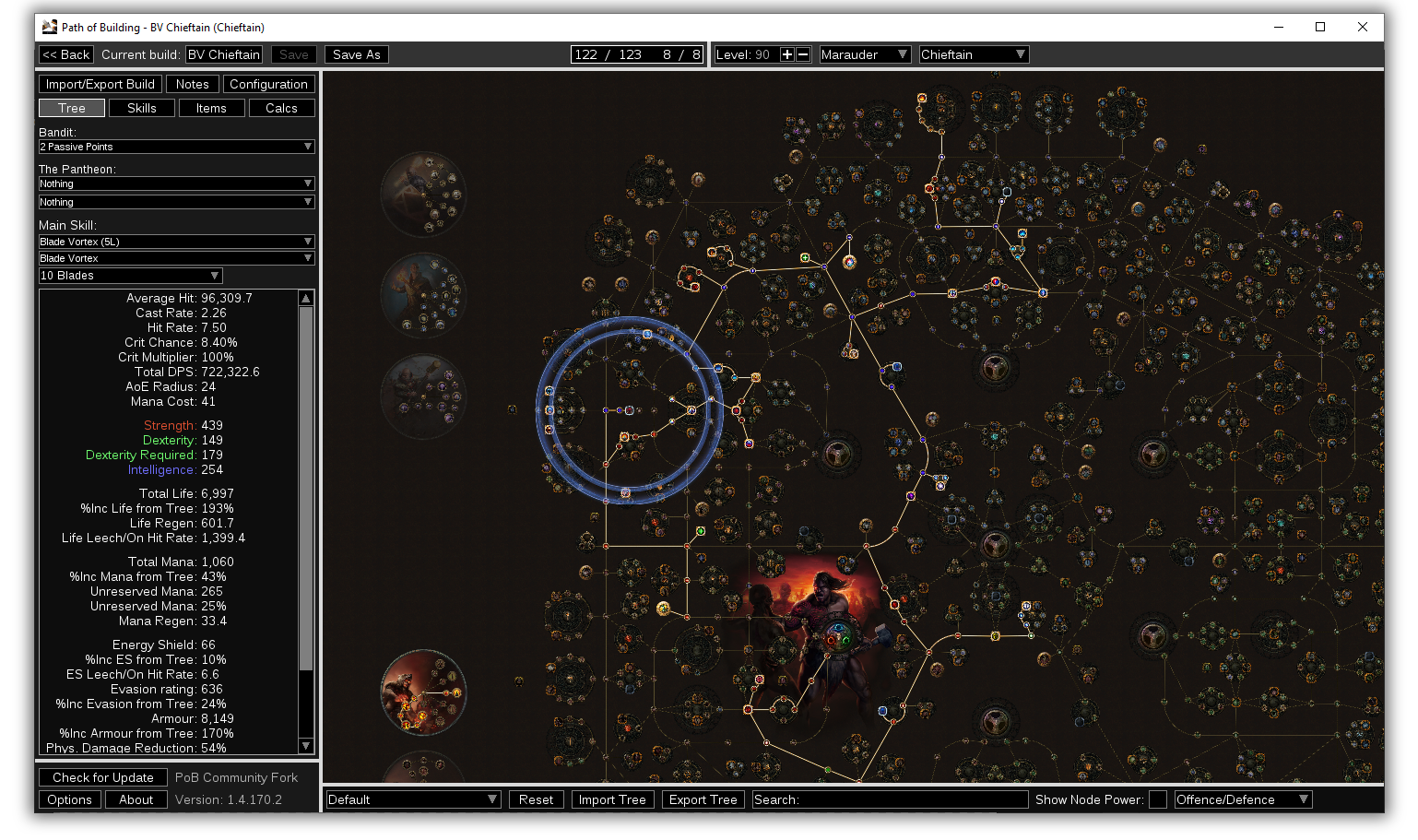
Diablo and PoE differ in tone and gameplay. One is darker and more story/world focused, which is what people tend to love about it, while the other is about management of extreme complexity. Path of Exile (and by extension the upcoming path of exile 2) is all about sinking thousands of hours into understanding game mechanics. The level of depth in that game is unmatched while the story is a complete clusterfuck. For example: you need third party programs to just help you understand how much damage you´re doing due to the number of variables that need to be accounted for https://pathofbuilding.community/images/pob_overview.png
Reason I say this is because if the parent comment is looking for something to try, it is important to keep in mind that PoE is really difficult for beginners to get into and play casually.
PoE isn't too hard to play in the beginning, as long as you learn the skill gem system (takes 5 min?)
But yeah it gets immensely complicated in the endgame. I've been playing for about a year now and am barely just starting to understand it.
That said, it's still a lot of fun. It took me a while to get over the frustration but once I did, it became one of my all time favorite ARPGs... and games, period.
It's totally free too. You only pay for cosmetics and optional extra bank (stash) space. A really fair monetization model that doesn't sacrifice the player experience, so on that front I totally support what they're hilding. (They are, however, owned by Tencent now sadly.)
Indeed, i remember that anecdote. I experienced the reverse first hand: multiplayer Angband has a clock/ticks and it completely transforms the game - but IMNHO ends up ruining the fun.
A24, I think, hit upon something that had been nagging at me for years in that Hollywood films are massive productions, several million dollars get poured into them. Not every film is a Marvel $250 million undertaking, but the recent Puss in Boots sequel costs about $90+ million, Dungeons and Dragons cost $150 million, heck even Halloween Ends cost $33 million (add a grain of salt for each of these figures). What's missing? $1 million, $5 million, $10 million.
This space between low budget and medium budget was, for a little while, nearly non-existent. With these budgets, you don't have to be that successful to get your investment in the black. It allows you to make riskier films, and there is clearly a market for films of depth and creativity. It boggles the mind that Halloween Ends required more budget (I assume it's mostly marketing) than Everything Everywhere All at Once, it's just about a guy killing people, in fairness one of those people was Jamie Lee Curtis.
Martin Scorsese and others have complained about this, but tend to get shouted down by Marvel enthusiasts, but yes: the mid-range films from studios have largely evaporated; as they run more like any other business, the focus is entirely on ROI and not at all on art, whereas studios (for most of their history) tended to balance out ruthless financials around their money-makers with a desire to set aside some of the profit for low-return, mid-budget works that skew more to the art side of things.
I went to see many small to mid sized films in the 1990s - 2000s, and heres the thing: it was often just 3 or 4 other people in the cinema. Seems like a misallocation of resources. The old system wasn't perfect either.
Nowadays the energy, ingenuity and talent that would have gone into making smaller films is instead going into making premium TV. I can see why cinema purists are upset by the shift to streaming, but as an audience member I'm currently getting an unlimited buffet of content on 3 streaming services paying about what I would have paid back in the day to see 3 movies.
> Nowadays the energy, ingenuity and talent that would have gone into making smaller films is instead going into making premium TV.
I hate this. I think 80-110 minutes is a good amount of time to tell a story. It's enough time to develop characters and build a world, but it's short enough that to be effective a film has to be ruthlessly edited.
Stories for TV are so bloated. Series like Stranger Things, Servant, The Last of Us and Russian Doll would have been perfectly suited to the movie format, but instead they get padded out to 8-hour seasons.
I should note I don't think this is true of all series, by any means. Lots of stories are well suited to the series format, like Succession, Dahmer or The Boys. And I know my opinion won't be a popular one because the runaway success of long bloated stories shows us which way the winds are blowing.
I have a similar opinion about series. They tend to become either repetitive or implausible over time, and they rarely have a decent ending. Too much time to fill and too little ability to plan ahead to avoid these.
The theatrical releases were probably a waste but these movies made their money on vhs and dvd sales. However, direct to dvd was considered a bargain bin only movie without prestige and theater appearances were and are required for Oscar contention so even then theater releases did make some economic sense.
On paper, a lot of these movies should have moved to direct to streaming but haven’t for whatever reason.
Yeah it's surprising how shallow the back catalogues of all the streaming services are. Currently they don't seem to be incentivised to acquire the rights to older content, because the flashy new stuff is what reels in the flashy new customers.
Would there be demand for a streaming service to host older quality content under a new umbrella, or maybe just a retro focused offshoot of an existing streaming service? Kind of like one of those old timey video stores that specialised in rare cult classics.
>the focus is entirely on ROI and not at all on art
A relation of mine went to England's best known acting school. Graduated and went to LA to start her career. Quit within two years saying, "I always thought it was about the art. It's not."
Martin's Scorsese's last film, The Irishman, cost over $175 million (not including marketing)...which actually puts it over the budget of most Marvel movies.
Blumhouse is the only big name actively doing 5-10 million movies.
Their trick is that they give a percentage to the actors and director and just a flat basic fee. Even "big" stars like Jennifer Lopez didn't get a million up front - she actually even used her own clothes for her Blumhouse horror movie.
They make a few flops, but their hits offset those easily. Paranormal Activity (their first one I think?) had a budget of $15k and made over $190 million in the box office.
$10 million hasn't been "medium" budget for Hollywood since the 1990s. In 1995, the average cost of a Hollywood film was approximately $34million. By 2003, that number had ballooned to $59 million. (https://www.latimes.com/archives/la-xpm-1995-03-08-fi-40252-...)
Today, the threshold for "medium budget" is somewhere around $30 million, with the threshold for "high budget" somewhere around $90-100 million.
Also, A24 is as Hollywood as you can get. Their offices are located in WeHo. All of their films are the kinds of films that Fox Searchlight and New Line Cinema specialized in.
(With respect to the films you mentioned, Puss in Boots and Halloween Ends both achieved profitability during their theatrical runs. D&DHAT did not make its budget back in theaters and is not expected to achieve profitability for several years if ever; it is very likely that it will not get a sequel, or if it does the sequel will have a much smaller budget.)
No, his point was that A24 is not doing the "typical" Hollywood thing, by focusing on low-to-mid budget films.
My point was that A24 (which is based in Hollywood) is just doing what New Line Cinema and Fox Searchlight (also based in Hollywood) did before them. New Line has since graduated to mid-to-high budget films due to the success of their early films like Scream. Searchlight still distributes arthouse films but under Disney has a significantly smaller budget to produce or acquire films; it's arguably more indie than A24 is now.
I would be all for a real push to follow in New Zealand's footsteps in enforcing a date of birth cut-off. Cigarettes, and nicotine generally, are horrendous and aside from having impacted me personally, put an unnecessary drain on public resources. They are wholly bad, and the rhetoric I've heard from people stating "you have to die of something" is, to me, entirely selfish thinking.
Are they a drain on public resources though? I’ve read that non-smokers have higher lifetime health cares costs because smokers on average die so much younger.
What I like about this system is that every time I've ever encountered this it's always been a laughable error. The last time, I weighed a carrot and it reported that I had actually weighed plums, despite the image clearly being orange and longer than most plums in a longest plum competition.


* From Hell (Some might be put off by the original comic's black and white art, but there was a recent release that colourised them by the original illustrator)
* Providence
* Jerusalem
* V for Vendetta