As a freelance product designer I'm always learning and always excited about work. There are so many interesting companies working on so many interesting problems.
It depends on the needs of the client, and Ive done a little bit of everything from designing moulds and sourcing factories for physical products, to writing frontend code to help ship.
Also found a report about another problem they cheated on tests to pass:
"They said the door trim on the affected vehicles had been modified with a "notch" to minimise the risk in testing that the door interior could break with a sharp edge and cause injury to an occupant when the side airbag deployed in an accident."
Stupid question: why didn't they add that part to the actual production cars? It doesn't sound like a complex system or problem (compared to say, reducing emissions versus just cheating in emission testing) especially since they already seem like they know exactly what they had to fix.
Even then I'd understand if it was a one time thing (rush in production or design, no time to redesign) but this is systematic and across a wide range of models. I guess the other models in question had more deeply rooted design issues that can't be fixed with a less intricate tweak?
The strange thing about that modification is that it appears on the surface to be a legitimate safety improvement. Could the underlying test be subpar?
why would that call into question the underlying test? Rather it calls into questions the design decision of the daihatsu team to know they could create a safer product but decide to not do so, and fake it on the safety tests.
Yeah med students seem to be unique in the amount of stuff they need to remember, at least in terms of users Ive worked with. The amount of things medical students need to memorize to pass their USMLE exams is insane. I designed and built a learning tool at a startup for med students using picture mnenomics and spaced repetition quizzing that seriously helped those students and lead to the startup being acquired.
I'm not the one you're asking, but I surprised you don't think that mnemonic isn't used in other domains.
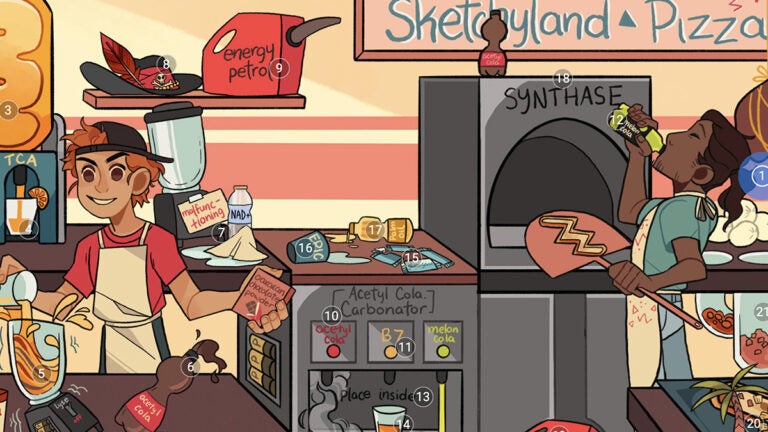
It typically doesn't look like a fully fleshed out pizza shop, but I distinctly remember explaining an cell scaffold that I had synthesized like a bowl of spaghetti and meatballs to some of the undergraduates I was mentoring..
I never felt that other domains didn't address the natural inclination to use abstraction as a way to convey concepts/processes.
but I'm _surprised_ that complex metaphorical images like the one in the parent haven't spread to other domains. As you said, we often make verbal metaphors when teaching, but explicit visual metaphors are _relatively_ rare. I'm talking about literal political cartoon as mnemonic device. How often do you see visual metaphors in textbooks? They're usually more interested in correctness.
Perhaps AI will make generating these images easier, if the difficulty in creating the graphics was the sticking point. Or maybe the problem is in sharing them, which is a problem that I'm working on.
It seems more like its to save money on office real estate and the fees that come with that like cleaning services, security, etc than it is about being employee friendly.
Unity is a worldwide company and while the HQ is now in San francisco, the origins lie in Copenhagen. There's physically no way to reasonably make everyone RTO because there are multiple big bases, and Unity was adjusted to telecommuncations well before the pandemic due to that.
So I'm not too surprised it chose to size down physical locations when push came to shove, compared to other tech companies in SV doubling down on their billion dollar real estate they built.
>There's physically no way to reasonably make everyone RTO because there are multiple big bases
Sure, but from what I saw a lot of these VFX/arts/game studios despite being international, still mandate their teams to be in-office a certain amount of days per week due to the nature of creative work. Especially that certain things like a games or VFX tend to not have their development spread internationally, but are usually developed by only a certain branch office, in which case some days of in-person collaboration might be more productive.
Yeah, games are in a weird place because console dev kits were paranoid as all hell when it came to usage. There'd be office mandates purely because you couldn't take those home, nor even remote into one without a bunch of red tape. There's still remnants of that to this day, which is probably why they couldn't be even more aggressive on remote status.
That is fortunately one big thing loosened over COVID, though; could never imagine having a devkit in my own house before 2020.
----
can't speak too much for the vfx industry. I imagine its similar culture and NDA contracts in terms of where content can "stay".
Devkits have been software locked for a while now and need an always on internet connectivity to the mothership to work, so even if the HW kit would leak onto e-bay, there's nothing you can do with them as they would immediately be backlisted and usually that leads to the studio being blacklisted as well for the blunder so it's natural the studios don't want them to leave the office. You never know which disgruntled employee would rage-quit taking the devkit with him leaving you to deal with the wrath from the console manufacturer.
When I was doing some security evaluations on a gaming console it was mandatory to lock the HW samples in a vault at the end of the business day when the last person to leave the office was done with them. Naturally that made WFH impossible even during covid.
Copenhagen is one of the most expensive cities in the world, also the employees are expensive and the candidate pool is smaller. And then there's the timezone issue as I assume most of the leadership is in the US.
Luckily for people like you and other people you know, most companies provide this, so please don’t ruin it for the few remaining companies that don’t.
Could Adobe be considered as creating it due to them generating AI assets on their servers in the cloud and not allowing users to do it with their hardware?
Unless I missed it, I don't see anything here about the assets being created using Adobe's AI services. Unless that is a requirement of Adobe Stock?
It seems like there are 2 distinct problems going on here. The fact that this is on Adobe Stock in the first place, which is questionable even if it was a legit image.
The second being it generated by AI, which is unclear what services made it.
Seems more objective to me in that the quest has shitty software beyond one or two games. One or two games wont carry a platform very long regardless of marketing. Shitty software hurts the hardware most.