I think you missed the point. The entire article is about specialists: astrophysicists. The problem with AI is that specialists are delegating their thinking about their specialty! The fear here is that society will stop producing specialists, and thus society will no longer progress.
You are assuming that set of specialists are fixed system! That's not the case. With change in technology, you would get more and more specialists, the same way Agricultural revolution allowed for more specialists to exist.
The author describes specifically how specialists are produced and how AI undermines their production.
No, we won't get more and more specialists literally "the same way" as the agricultural revolution. You need to be much more specific about how we'll get more specialists under the incentive structure created by AI, otherwise this sounds like some kind of religious faith in AI and progress.
> I can't tell what specialists we will get the same way you wouldn't be able to tell me we will have Linux Kernel specialists at the year 1945.
How about addressing astrophysics specifically. What are you claiming about it? Are you claiming that in the future, we won't need astrophysicists at all, AI can do all of our astrophysics for us, freeing humans to specialize in... other subjects?
And doesn't the same problem exist for Linux kernel specialists? Why even become a Linux kernel specialists when AI can write your source code for you?
> people become specialists
This is precisely what is in question.
> A mathematician in 1500's wouldn't think algebraic topology would be a specialisation.
The specific subjects have changed over time, but the production of specialist mathematicians hasn't really changed. It takes hard work, grunt work, struggling, making mistakes and learning from them, as well as expert supervision. The problem with AI is that it encourages and incentivizes intellectual laziness, the opposite of what is required to produce specialists.
A related problem: LLMs have been trained with papers written and supervised by Alice-type specialists. There's a common claim that LLMs will hallucinate less in the future, but I think that LLMs will hallucinate more in the future, when specialty fields become dominated by Bob-type "specialists" who have a harder time distinguishing fact from fiction. When LLMs have to train on material produced by earlier versions of LLMs, the quality trend will go down, not up.
> The specific subjects have changed over time, but the production of specialist mathematicians hasn't really changed. It takes hard work, grunt work, struggling, making mistakes and learning from them, as well as expert supervision. The problem with AI is that it encourages and incentivizes intellectual laziness, the opposite of what is required to produce specialists
Let's take the example of economics. Economists use ideas in Mathematics like integrals, statistics, PDE's and so on. They know that these concepts exist. They know how to apply them. They don't know these concepts deep enough to make progress here.
Do you think that Economists should deeply learn integrals, PDE's, Functional Analysis and Differential Geometry and all other concepts they use? Or do you think its better for them to focus just on their specific domain while learning just enough from other domains?
You keep coming back to AI replacing mathematicians. I'm not making that claim. I'm not saying Linux kernel specialists will be replaced by AI. I'm simply claiming that not everyone needs to be Linux Kernel specialists. This is precisely what AI is allowing: it automates things I don't need to know deeply so that I can focus on things I do need to understand deeply.
> I'm simply claiming that not everyone needs to be Linux Kernel specialists.
This is an uninteresting and indeed silly claim, because nobody has ever asserted the opposite.
The point is that society needs some Linux kernel specialists, and some astrophysicists, but AI is undermining their production.
> This is precisely what AI is allowing: it automates things I don't need to know deeply so that I can focus on things I do need to understand deeply.
The submitted article is about how AI is automating the things that a specialist does need to understand deeply. It's about so-called astrophysicists using AI to produce astrophysics papers, not about how non-astrophysicists use AI to produce astrophysics papers so that they can focus on whatever their non-astrophysics specialty may be, if they have any specialty.
> Frank Herbert (yeah, I know I'm a nerd), in God Emperor of Dune, has a character observe: "What do such machines really do? They increase the number of things we can do without thinking. Things we do without thinking; there's the real danger." Herbert was writing science fiction. I'm writing about my office. The distance between those two things has gotten uncomfortably small.
If we both agree that an astrophysicist may not need to understand things (even in their own domain) to make progress then we are in agreement. Not all the things a researcher works on while writing their paper is useful or necessarily done by them manually. In such cases it becomes necessary to let LLM take over.
> > Frank Herbert (yeah, I know I'm a nerd), in God Emperor of Dune, has a character observe
The article author and I share a love of Frank Herbert, God Emperor of Dune, and the quote in question. Nonetheless, it's a mistake to focus on this quote rather than on the rest of the article. The quote is nothing more than a nice literary reference; it's not central to the argument.
The character who spoke the quote is a magically prescient human-sandworm hybrid, thousands of years old, speaking to his distant relative who was specially bred by him to be invisible to the magical prescience, so let's take the quote with a grain of... sand. ;-)
> If we both agree that an astrophysicist may not need to understand things (even in their own domain) to make progress then we are in agreement.
Your parenthetical remark is actually the main problem!
... on a website owned by the VC that invested in the developer.
I believe that the ideas in the blog post are novel enough and should spark curiosity and interesting discussions. Also I submitted this last week, someone must have hand-picked and given it another chance because it's a good fit for HN.
The key phrase is "kind of thing". It certainly does matter what kinds of things we focus our attention on as a species. I think you would have to be quite cynical to think that progress in spaceflight over the past 60+ years hasn't had a positive impact.
Global rates of poverty are 83% lower than they were in 1969 when we landed on the moon.
So actually, millions of lives have massively benefited from science and technology. To be cynical in the face of all that is a personal take, not a reflection of the facts.
Vaccines, Mobile Phones, Internet, GPS (How do you think container ships navigate), High yield seeds/fertilizers and the Green Revolution, Weather Satellites, I could go on.
It's really getting tiring repeating this stuff over and over again to the anti-space crowd.
You’re arguing against the misanthrops. To them, nothing humans could do would be good enough. We could end slavery in the West and they’d accuse us of not ending slavery enough.
Vaccines were invented during the moon landings? High yield seeds and fertilizers are due to the moon landings? The internet was invented due to the moon landings?
You didn't provide any citations that show any of the above has lifted people out of poverty. Please go on, and maybe tell us how ships navigated the seas before GPS, sounds impossible.
There are no causal connections between going to the moon and lifting global poverty. In fact, the money spent on going to a dried up satellite could have lifted people out of poverty.
I'm sorry, so now it's not capitalism, technology, or the moon landings, but the cold war context? Could you pick a specific "event" you believe lifted so many people out of poverty, and provide research or supporting documentation?
You don't solve these problems in a single step, but notice how space imagery and analogies pop up every time people try to talk about peace, global problems, mutual empathy, understanding, etc. The Pale Blue Dot, images of Earth from orbit or the Moon, etc. Those are anchors in public consciousness, competing in memetic space with usual divisive, dystopian, hope-draining pictures and soundbites - we need more of them to improve on the big problems, and we absolutely would not have them if not for people actually flying to space.
Or, put differently, space exploration is one of the few things "feeding the right wolf" for humanity at large.
It's crazy to believe that people who believe in one holy book are killing people over another holy book in countries like (but certainly not limited to) Nigeria, while another country launches people to the moon.
But, alas, I agree with you. There's no way out but through I guess.
You seem to be forgetting that the country launching people to the moon is primarily of one holy book and is currently bombing the people of another holy book.
The United States is not a Christian country and is not at war with anyone due to religion. I know you're talking about Iran but Iranian Christians are as affected as Iranian Muslims. Muslim countries in the area have pushed America to continue this war.
I am completely against this military excursion. Just an honest takeaway. A lot of rhetoric in America on religion is due to people's religious trauma. I blame American evangelicals.
Nobody it'll say space exploration will alone solve those problems. But it helps, and can help more - much more, if we go all the way in and establish permanent economic activity and eventually settlements in the space near Earth and beyond.
> if we go all the way in and establish permanent economic activity and eventually settlements in the space near Earth and beyond.
Could you please explain exactly how these would help to stop war and inequality?
As far as I can tell, space exploration is going to exacerbate inequality, for example, by making Elon Musk even more obscenely wealthy than he already is.
> Is the problem inequality or rather poverty? Because those are not the same thing.
According to the OP, inequality: "Regardless of whether this particular mission is perfectly planned, this is precisely the kind of thing that will help humanity outgrow the dark age of war, inequality and climate mismanagement."
> What we've done in space has absolutely helped with poverty. It makes weather forecasts possible, which helps even the poorest farmers.
Are you talking about manned Moon missions or unmanned Earth-orbiting satellites? To use your own words, those are not the same thing.
In any case, poverty is a policy decision, a refusal to redistribute the wealth.
This is a policy decision insofar as the policy isn’t to liquidate entire groups of people over class and status resentment. “Just redistribute the wealth bro, it’ll work this time bro I swear let’s just do a redistribution”.
NASA may be cool, but the main reason SpaceX was able to undercut old launch providers was all the I Can't Believe It's Not Corruption of pork barrel spending by those old launch providers.
So SpaceX made space cheaper, was good value for the US taxpayer, and was also a money transfer scheme from the government to him. (Worse with Tesla, but this isn't about Musk just SpaceX).
That said, now there's questions about if Musk is corrupt with all those US government ties that result in suspicious direct pressure on non-US governments, including with Starlink which even if theoretically separate to SpaceX is obviously functionally inseparable at present.
> NASA may be cool, but the main reason SpaceX was able to undercut old launch providers was all the I Can't Believe It's Not Corruption of pork barrel spending by those old launch providers.
FWIW, SpaceX did literally what NASA paid them to. It might be no one dared to hope that the Commercial Space budget will turn out so spectacularly effective at disrupting legacy structures of corruption, but the point of the exercise was still to pay private players like SpaceX to make access to space cheaper, and they absolutely delivered on that. This wasn't a competition between public and private interests, it was a successful cooperation.
> So SpaceX made space cheaper, was good value for the US taxpayer, and was also a money transfer scheme from the government to him.
Obviously paying someone to do something is a money transfer, and if the payer is the government and recipient a private organization, it is a transfer of money from government to private interests. Same happens every time a federal employee buys a coffee on their way to work.
I think that helping the less fortunate is cool, and launching people to the Moon is lighting money on fire for utopian and inevitably corrupt money transfer schemes.
That's part of a general meme shift. 60s tech was defined by a mix of fear, awe, and optimism. Apollo had elements of all three.
There was a confidence underlying all of them. From the New Deal to the late 60s, there was a public belief a better future was possible.
2020s tech is defined by fear, pessimism, and dystopia. The utopian edge has either gone or been replaced by horrific anti-utopian tech - surveillance, manipulation, exploitation, and irrationality.
Tech has become anti-science. Musk's DOGE cut around $1.5 of science funding, science education, and NASA exploration.
The naive sense that a better future is possible, and tech will make it happen, has almost disappeared.
> > The previous Moon missions certainly didn't accomplish that.
> Sparked the environmental movement, to name but one major impact.
It...really didn't. There was a new wave with a different political orientation (less conservative/elite) in the environmental movement roughly contemporary to the space program from—the 1950s through the 1970s—but it was driven by a variety of human driven (nuclear testing, oil spills, etc.) environmental disasters combined with more modern media coverage that occurred in that time than by the space program itself.
I know there are people who try to ignore all that and pretend that the whole thing was just the Earthrise photo in 1968 but much of the development of the new character of the movement happened before Earthrise, and even what happened after generally clearly had other more important causes.
Regardless of what you think of those first shots from Apollo 8, you have to admit they put things into a different perspective for a lot of people. Seeing the whole of the Earth like that moved a lot of people into realizing this planet is worth saving. That one image was a significant moment causing such a spike in people paying attention that it can be forgiven for being confused as the thing. It's not like John Muir needed to see the Blue Marble image to start his movement. It's just so many more people did
> Regardless of what you think of those first shots from Apollo 8, you have to admit they put things into a different perspective for a lot of people.
“Regardless of what you think about X, you must think Y about X” is a particularly tiresome rhetorical device, but its also being deployed as part of a motte-and-bailey argument here.
> It's not like John Muir needed to see the Blue Marble image to start his movement. It's just so many more people did
Blue Marble (1990) is a completely different image than Earthrise (1968), and Earthrise was only adopted as a symbol of the environmental movement because the movement was already ascendant when it came out, not because it was the trigger for it.
Disagree about the change. Even the fact that you know and care enough to argue this on-line is a change that can be attributed to space missions - and it's even more true about the overall global conversation about climate situation, and all activities taken to help with it.
The CEO is an employee of the board of directors and the stockholders. An AI CEO would no doubt be as ruthless as a human CEO, if not more so. In other words, I wouldn't anticipate any improvement in CEO behavior.
If I was going to reduce labor costs by +1M/year, I would rather eliminate 1 CEO then 10 radiologists. I would much rather have 1 unemployed CEO in society than 10 unemployed radiologists. At the very least, "AI" should replace through attrition rather than direct layoffs...
Missing the point. If CEOs realize that they're more replaceable by AI than nurses and medical assistants, for example, then maybe they'll take a more nuanced view of the technology.
No, you're missing the point, because the views of the people to be laid off are irrelevant. Again, the stockholders own the company, not the CEO. If CEOs start chaging their tune on AI as soon as their own jobs are at stake, that would just demonstrate to the stockholders that human CEOs are untrustworthy and need to be replaced.
Before AI came along, CEOs were already arbitrarily laying off workers, to please the stockholders. The stockholders like these cost-cutting measures, and whether the measures make sense is secondary to the CEOs doing what their bosses want. If the stockholders believe that they can cut the CEOs too, they surely will.
I disagree. What's new is that this flattery is individually, personally targeted. The AI user is given the impression that they're having a back-and-forth conversation with a single trusted friend.
You don't have the same personal experience passively consuming political mass media.
Yes it’s final form of the evolution that social media started.
Village idiot used to be found out because no one in the village shared the same wingnut views.
Partisan media gave you two polls of wingnut views to choose for reinforcement.
Social media allowed all village idiots to find each other and reinforce each others shared wingnut views of which there are 1000s to choose from.
Now with LLMs you can have personalized reinforcement of any newly invented wingnut view on the fly. So can get into very specific self radicalization loops especially for the mentally ill.
Reddit? Or this site? Sort of? Some people voted for my comment, that surely means that I'm right about something, rather than them just liking it, right?
The footnotes appear to the left of the main body of text around the position they appear in (viewing in a desktop browser). The article has grown a third note in the meantime and these are all visible now.
The 2013 trash can was the end of the Mac Pro. It was never the same after that. The 2012 and earlier Mac Pros were awesome. I had a 2010 model. Here's what I loved:
• Multiple hard drive bays for easy swapping of disks, with a side panel that the user could open and close
• Expandable RAM
• Lots of ports, including audio
• The tower took up no desktop space
• It was relatively affordable, starting at $2500. Many software developers had one. (The 2019 and later Mac Pros were insanely expensive, starting at $6000.)
The Mac Studio is affordable, but it lacks those other features. It has more ports than other Macs but fewer in number and kind than the old Mac Pro, because the Mac Studio is a pointlessly small desktop instead of floor tower.
That's when they stopped designing computers for the pro market and started selling mid-century Danish furniture that can also edit videos.
I knew it was all over when third party companies had to develop the necessarily-awkward rack mount kits for those contraptions. If Apple actually cared about or understood their pro customers, they would have built a first party solution for their needs. Like sell an actual rack-mount computer again—the horror!
Instead, an editing suite got what looked like my bathroom wastebasket.
When it was introduced, Apple said the trash can was a revolution in cooling design.
Then they said they couldn't upgrade the components because of heat. Everyone knows that wasn't true.
By the time Apple said they had issues with it in 2017, AMD were offering 14nm GCN4 and 5 graphics (Polaris and Vega) compared to the 28nm GCN1 graphics in the FirePro range. Intel had moved from Ivy Bridge to Skylake for Xeons. And if they wanted to be really bold (doubtful, as the move to ARM was coming) then the 1st gen Epyc was on the market too.
Moore's Law didn't stop applying for 6 years. They had options and chose to abandon their flagship product (and most loyal customers) instead.
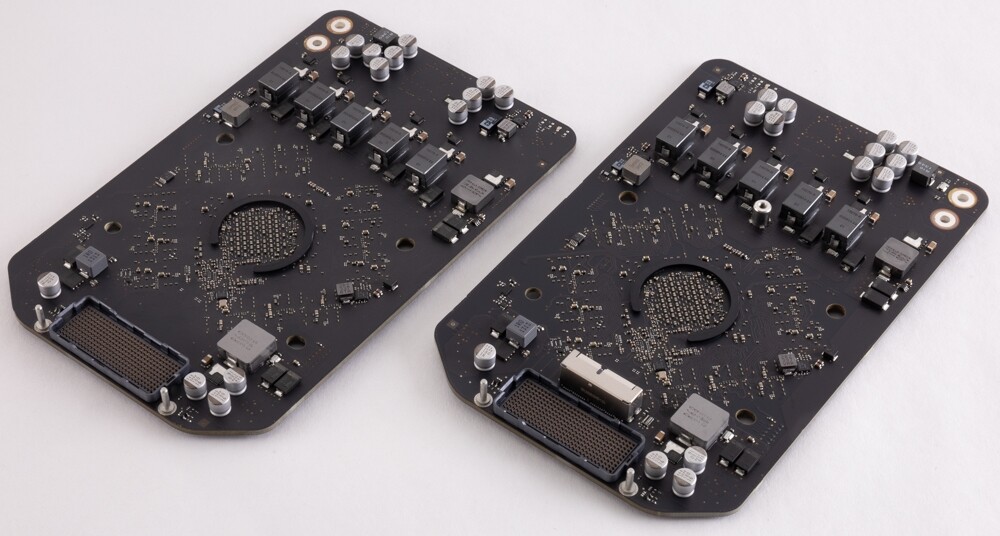
The biggest issue was actually that the Mac Pro was designed specifically for dual GPUs- in the era of SLI this made some sense, but once that technology was abandoned it was a technological dead-end.
If you take one apart you'll see why, it's not the case that you could have ever swapped around the components to make it dual-CPU instead; it really was "dual GPU or bust".
Somewhat ironically, in todays ML ecosystem, that architecture would probably do great. Though I doubt it could possibly do better than what the M-series is doing by itself using unified memory.
I'll admit that while I've used the trash can but never taken it apart myself. But I can't imagine it would have been impossible to throw 2x Polaris 10 GPUs on the daughterboards in place of the FirePros.
For what is essentially a dead-end technology, I'm somewhat doubtful people would have bought it (since the second GPU is going to be idle and add to the cost massively).
the CPU being upgraded would have been much easier though I think.
Apple even in 2017 had the money and engineering resources to update or replace their flagship computer - whether with a small update to Skylake & Polaris and/or a return to a cheesegrater design as they did in 2019.
But they chose not to. They let their flagship computer rot for over 2000 days.
Aside from the GPU mess, the 2013 was a nice machine, basically a proto-Mac Studio. Aside from software, the only thing that pushed me off my D300/64GB/12-core as an everyday desktop + front-end machine is the fact that there's no economically sensible way to get 4K video at 120 Hz given that an eGPU enclosure + a decent AMD GPU would cost as much as a Mac mini, so I'm slumming it in Windows for a few months until the smoke clears from the next Mac Studio announcement.
At which point I'll decide whether to replace my Mac Pro with a Mac Studio or a Linux workstation; honestly, I'm about 60/40 leaning towards Linux at this point, in which case I'd also buy a lower-end Mac, probably a MacBook Air.
I'm in the Linux desktop / Mac laptop camp, and it works well for me. Prevents me getting too tied up in any one ecosystem so that I can jump ship if Apple start releasing duds again.


Not in my testing.
reply