Exact geographic measurements where the high technology of 18th century. Each society uses the highest precision measurements available to them. Also, plate tectonics were scifi fantasy until 1950's.
No. If a hydrogen atom makes a transition "there", then it does so with a frequency determined by the clock "there", at the point where the transition happened. If we detect the emission "here", we see both the red shift and the time dilation between "there" and "here", and we see them in exactly the same way - as a frequency shift.
Your question about pulsars is a good one and I'll answer it first, but the study at the top is about quasars, and I'll address that further below.
With one exception all known pulsars are in the Milky Way; they are too intrinsically dim (and obscured by dust, much of which is local to them, produced in their progenitor star's explosive demise) to see them at extragalactic distances. The exception is PSR J0540-6919 in the Large Magellanic Cloud (the LMC, a satellite galaxy to the Milky Way), which is atypically bright in gamma rays and so is visible to the Fermi-GLAST telescope in low Earth orbit.
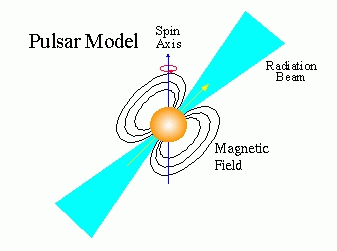
Pulsars have unique periods, ranging from about a millisecond to about ten seconds. The period is determined by a number of factors including the rotation rate (spin), the offset of the beam from the spin axis, precession of the beam axis and the spin axis, differential rotation within the pulsar, time-dependent collimation of the beam, and so on. Here's a quickie image: <https://www.astronomy.ohio-state.edu/ryden.1/ast162_5/pulsar...>. When we see a pulsar we are catching some of the cyan-shaded region as it's dragged around the spin axis. In the case of linked diagram above, if we are way to the below-left, we would see the strongest part of the pulse about once per full rotation.
Some pulsars have highly predictable periods of a few milliseconds; this pulse rate can be stable for decades. Other pulsars are subject to occasional and unpredictable speed-ups and speed-downs. These are probably driven by the movements of relatively large internal structures and/or the infall of material onto the crust of the neutron star (its own supernova debris, or gas from a binary-or-multi-star partner).
Since all but one discovered pulsar is in the Milky Way and the LMC is close enough, there is no cosmological redshift involved in pulsars. We may eventually have telescopes powerful enough to spot bright pulsars at the margins of other galaxies, but not soon. When we can, it will be interesting to see what spectral features have a redshift dependence.
Now, on to quasars and the study press-released at the link at the top of the page.
Variable quasars only work vague like pulsars where we substitute a few solar mass neutron star a few thousand light years away for a billions of solar mass black hole near the centre of a distant galaxy billions of light years away. Dust and gas around the distant supermassive black hole generates a magnetic field which causes a relativistic jet to form, in which charged particles from near the black hole are swept into a long tube and thrown far away from the black hole; in the process these charged particles (especially electrons) emit synchrotron radiation, which we detect. All quasars are extragalactic -- there are none very close to us -- so all quasars have some nonzero redshift distance.
The periodicity of variable quasars probably has little to do with the spin of the central black hole, which can be one rotation every few hours up to practically not rotating at all. Quasar variability is best measured in months. We tend to conclude that we only see bright quasars when the beams are always pointed in roughly our direction (and that quasar beams are very wide because they spread out with distance). This should hold true no matter how quickly or slowly the black hole is spinning. The study summarized in the link at the top is in part a check on that.
As to the light (and radio and gammas and so on) from bright quasars, astronomers mostly pay attention to are broad emission lines (BELs) that appear and disappear; these are the "changing-look quasars" (CLQ) and the optical luminosity varies enormously (> order of magnitude detected here). The CLQ BELs are predictable enough that they can reveal the redshift on the emission lines particularly the ones in the mid-infrared, giving a distance to the CLQ.
There are also quasars that brighten and dim without a change in spectral lines, the so-called changing-state quasars (CSQ); the most highly-variable quasars (HVQ) are CSQs. The mechanisms for variability for CLQs and CSQs differ, but both have to do with dynamics in the accretion disc rather than being directly driven by the black hole spin.
Unlike pulsars which have bright/dim periods of milliseconds to seconds, highly variable quasars have bright/dim periods best measured in months. Pulsars also generally run on a bright/dim/bright/dim/... cycle or (for a favourable orientation) bright/dim/VERYbright/dim/bright/dim/VERYbright/... but variable quasars can get brighter And brighter AND brighter and then suddenly quite dim and then brighter and dimmer and so forth, with practically no predictability (It's "stochastic"). The brightening and dimming can be at different wavelengths, presumably because the accretion disc (bright in most wavelengths) is hidden behind host-galaxy dust and gas (which appears as thin spectral lines, redshifted according to distance).
For near-experts wanting to know more about CLQ vs CSQ, the CRTS transient survey has a nice overview <https://arxiv.org/abs/1905.02262> (see fig 1.).
The study summarized at the top and in preprint found at <https://arxiv.org/abs/2306.04053> focuses on the differences in luminosity variability in different wavelengths in CSQs. Roughly, the absorption lines near the quasar and in gas and dust and so forth between the quasar and us imprints the spectrum in a way that allowed the authors to sort many quasars into initial groups ("buckets") with common spectral features. In this study the preserved freatures are the relative brightness at a number of wavelengths seen by different telescopes. As long as the varying brightness doesn't cause quasars to be ejected from their initial buckets, the cause of the variability is not related to a redshift (neither because of local motions in the host galaxy, or local motions of Earth, nor because of cosmological redshift). Consequently cause of the variability must be either very local to the quasar or very local to us. Since quasars in a bucket are scattered across the sky, the reason for the variability is most likely not something local to us. Also we would struggle to explain why quasars might look variable due to some near-Earth influence, but why type Ia supernovae (and your friends the galactic pulsars) do not.
If one decides the variability is caused by something local to each quasar, but not having to do with the quasar's meanderings through its host galaxy, then one compares the variability period of quasars in a bucket. It turns out that, for each bucket (with ~identical strengths in each of a set of wavelengths), the varability period (each dimming or brightening event) is longer at higher redshift. This is consistent with an expanding universe identical to the one in the standard model of cosmology.
So if I understood you and the original paper correctly, this observation is not in conflict with the Standard Model or Lambda-CDM and that this is an observational outcome of general relativity. Is that a correct statement? If so, then those models may need to incorporate why this may have happened, right?
Edit: Thank you for the detailed post. Learned a few things from it.
It's support for \Lambda-CDM, which is the standard model of cosmology. The standard model of particle physics is only involved to the extent that it explains spectral emission and absorption lines in the first place; locally the physics of electromagnetism vs hydrogen ions (among others) works the same over-there-back-then and here-and-now.
Sorry that there's two "standard model"s. One often hears "concordance model" or "standard cosmology" or \Lambda-CDM instead, as a result.
This study's novelty is in showing that [a] the changing luminosities of both families of variable quasar can be usefully compared and [b] similar variable quasars have similar luminosity-changing rates at similar redshift; if the redshifts differ, the less-redshifted one's brightness changes more frequently and more quickly.
Some missing features: give access to terminal, bypass captchas, allow online payments, use a bank account, let it use a phone using TTS, let it generate photos and post on internet...


Doesn't sound like a good idea. Circumference of earth around Paris is not unchangeable.