He was a brilliant innovator that added value to the world. He was a failed entrepreneur that did not recapture part of the value he created. That makes him a huge success in my books but I wish he was more comfortable and content in his final years.
SQLAlchemy 1.4.0 Released – featuring major rethink of the APIs in Core and ORM [1] HN thread from yesterday and Migrating to SQLAlchemy 2.0 [2] from 26 days ago.
The climate switched from 41 kyr glacial cycles to 100 kyr cycles about a million years ago. Greenland experienced regular interglacials during the 41 kyr cycles. None of this is surprising except that climate change obsessed scientists, journalists, and HN commenters appear to be unaware of the Marine Isotope Stages.
The sediments below the western and eastern Antarctic ice sheets should show similar signs of interglacial activity timed to their own transitions to permanent glaciations.
Written by Thomas Chatterton Williams [1], author of Self-Portrait in Black and White [2]:
> “It’s not about color for me,” my aunt said while railing against Obama. “For example, I love Thomas Sowell.”
> To that side of my extended family, I became the stereotype of a coastal liberal, writing for the New York Times and wholly out of touch with the real America. In fact, I’ve always prided and defined myself as an anti-tribal thinker, and sometime contrarian, working firmly within a left-of-center black tradition...
Why was this published in Law & Liberty, has he burned his left-of-center media bridges?
Yes and no. He doesn't burn bridges, but left of center media elites pull up the drawbridges.
On topics like this, they view college activists as authoritative, objective sources of truth on race. Those activists view Sowell, and TCW, as heretics.
Recall also progressive journalist Lee Fang, who endured a cancellation campaign from colleagues at The Intercept because he Tweeted an interview with a black man who expressed concern about black-on-black crime. Many progressive activists and the media also aren't especially keen on Glenn Loury, John McWhorter, Razib Khan, or dozens of other outspoken people of color. There seems to be some strong compulsion in the media to suppress any indication that people of color (and blacks in particular) are as complex and intellectually or ideologically diverse as whites. I don't think that's quite the right characterization, but it's not far off.
I grew up in a mostly black county in Virginia, and at one point lived temporarily in the household of a family of socially prominent black Christians. The father was a police officer, the mother a public defender in a neighboring county. The father was not quick to anger, but the angriest I ever saw him was when a bunch of white anchors in NYC on MSNBC brought on Al Sharpton, and asked him questions about what "black America" felt about an issue. He pointed out to me that they would never bring a white person from NYC on to a channel and ask him what white people in Virginia thought about an issue.
My general impression is that the portrait we get from the media about "black America" is actually only accurate for something like 10-30% of black Americans (i.e., progressive black Americans). For example, the "defund the police" movement was marketed by the media (question #1 might be "why is the media marketing anything?" but ignoring that for now...) as a movement that black Americans wanted, but subsequent polling suggested that only a small minority of black Americans wanted less policing. I would bet that these beloved-by-the-media, "pro-black" policies are supported by a smaller share of blacks than wealthy progressive whites.
It's interesting (or it would be were it not tragic) because there seems to be an increasingly popular belief that there is some "true Black" way of seeing the world. Some people will call a black person who deviates from the stereo-type, "not 'politically black'" or suggest that they have "internalized white supremacy" or "minority whiteness". They argue that "worship of the written word", "objectivity", "wester civilization", etc are traits of white supremacy as though there is some force of nature that compels blacks toward a certain set of experiences and a certain way of processing those experiences which ultimately results in a very homogeneous, narrow set of "black opinions"--and deviations from that narrow band of opinions are regarded as pathology. It's almost as though they see blacks and people of color as a distinct species from whites, that white people are so incapable of understanding black people that, on the basis of race alone we are compelled to preclude whites from volunteering with a school board or translating the work of black poets (although it's fine for a white person to translate Shakespeare or ancient Greeks, suggesting the experiences of contemporary whites and blacks is more divergent than two white people separated by centuries or millennia).
Personally, I don't understand how this sort of ideology is supposed to get us closer to a post-racial world.
> Why was this published in Law & Liberty, has he burned his left-of-center media bridges?
No, left-of-center media is under the throes of the cultural far left, and they "de-platform" anyone who doesn't adhere to their ideology.
So conservative media, along with non-traditional dissident media like Quillette, are often the only place dissident liberals like TCW can be published.
European AstraZeneca supply is not being shipped to the USA. The FDA will not approve AZ until the ongoing local phase III trial is complete. In the meantime, the U.S. export restrictions still apply to American manufactured AZ doses:
> The EMA has said that as of March 10, a total of 30 cases of blood clotting had been reported among close to 5 million people vaccinated with the AstraZeneca shot in the European Economic Area, which links 30 European countries.
"The decision today is purely precautionary..." given this level of signal. We don't have details on the age groups involved and the normal rates expected but I can hazard a Fermi Estimate that the risk is minuscule compared to COVID-19 itself. I look forward to seeing the actual data in coming days/weeks. Precaution without downside is acceptable; this is not one of those cases, IMO. YMMV.
> the risk is minuscule compared to COVID-19 itself
You don't know this at all - we don't know what age groups are affected here, and COVID is pretty much negligible in many younger age groups. It's best to wait for more data to come in before drawing any conclusions.
The risk *of death* from COVID is pretty negligible for some age groups. The biggest confusion of this whole situation is we've fixated on CFR numbers as a measure of risk.
Risks of long-term consequences don't seem to be all that low.
I haven't seen anything that indicates that the risk of long-term consequences is significantly elevated above other viral diseases. There is a condition (which we know too little about, and which - as one of the few good outcomes of the COVID situation - is now actually getting some attention) that can lead to fatigue and other symptoms after fighting off a viral infection, but it's not unique to COVID.
A year ago there was a lot of noise about things like heart issues induced by COVID, which turned out to be mostly statistical errors in the papers that made the claims.
A lot of people (often people who never actually had a positive test) also claim to suffer from various mental impairments after their COVID infections, and some newspaper ran an article saying that some of these symptoms were alleviated after the people were given anxiety medication. Go figure ...
There is no evidence of the link between sleeping sickness, EL, and Spanish flu.
> Since encephalitis lethargica’s (EL) prevalence in the 1920s, epidemiological and clinical debate has persisted over whether EL was caused by, potentiated by, or merely coincident with the Spanish influenza pandemic. Epidemiologic analyses generally suggest that the disorders were coincidental.
There is nothing to play down. More than a year into the pandemic are there is still no evidence of long-term damage except in rare cases. Evidence of inflammation in monkeys does not qualify, before you ask.
Someone very close to me is a “long hauler” and the quality of life effects have been horrible. A young and healthy person, now dealing with fatigue, blood clotting, and a host of other uncomfortable and troubling issues. Throughout, medical professionals have been struggling to give people like this answers as to what exactly is happening to them — and the common refrain is “we don’t knew enough about it yet, but we’re seeing a lot of this.”
I’ll let the eventual studies give the percentages. But my (personal, non professional) take on this is that long-hauler experiences are a LOT more common then people realize, have been fairly ignored while people have fixated on the death count, and have big possible implications for quality of life for younger, otherwise healthy people.
Agree fully, although even the mortality numbers far outweigh the thrombosis incidence!
Long covid:
> Estimates of the number of people with long COVID vary widely. In July, the US Centers for Disease Control and Prevention reported that one in five patients 18–34 years of age without chronic medical conditions and with a positive outpatient test had not fully recovered by 2–3 weeks after testing, and a research center in Rome found that 87% of 143 patients reported persistence of at least one symptom 60 days after onset of the disease. According to a preprint published in October that has not yet undergone peer review, 24% of 233 patients still had symptoms at 90 days after infection. Data from a smartphone app, as reported by the COVID Symptom Study, showed that one in ten patients with COVID-19 have symptoms after 3 weeks. Given the scale of the pandemic, if even only a small percentage of the tens of millions of infected people worldwide develop long COVID, a staggeringly large number of people would need long-term follow-up and treatment.
> COVID is pretty much negligible in many younger age groups
"Paediatricians in Israel, which has surged ahead in vaccinating its adult population, reported a sharp rise in covid-19 infections among young people, with more than 50 000 children and teens testing positive in January—more than Israel saw in any month during the first and second waves."
Susceptible to infection, absolutely, but are they suffering severe symptoms or dying in large numbers? No.
A single metric (e.g. positive tests) is not enough to assess any severity here, and even those metrics come with caveats because all of our methods of determining them are imprecise.
> Moreover, the database is not a representative sample of the sars-cov-2-positive population. Because it only contains records from people who have interacted with a medical service provider, it excludes those who weather the disease at home without medical assistance.
This will exclude the vast majority of people in younger age groups who were affected. Serology studies have shown us that in many densely populated places infection rates have been far into the double-digit percentages - if this statistic was true in the way you interpreted it, we would know that by now.
i.e. if a very large number of young people get sick, there will be sufficient severe cases among their population to fill up intensive care beds and there will also be many people with sequelae.
But in Germany and Europe children can't get vaccinated and by the time young adults can it will be September anyway.
Then why not temporarily suspend vaccinations only for those under 40? Or let people have a choice in determining whether the risk is worth it for them.
I would love to have a choice in determining whether the various risks are worth it for me, but my government has insisted on shutting all "non-essential" businesses, and only lifted a 3-month "stay at home" order last week.
That’s not really the same thing since an individual who, for example, goes to large gatherings also endangers others by making essential activities like going to the grocery store more dangerous for everyone. Besides that, wider spread of the virus increases the odds of dangerous mutations that make the vaccine less effective or the illness more severe. More spread also risks hospital overloads, which will hurt the medical outcomes of everyone. Going out beyond essential needs hurts everyone.
On the other hand, getting a potentially faulty vaccine would seem to mostly only be a risk to the individual, although I suppose there is some risk of overwhelming hospitals still.
Please just stay home for a few more months so this shit can finally fucking end. It’s already been a year.
Edit: an important factor, too, is that understanding the potential risks of the AZ vaccine is hard, and the average person may not expected to fully understand them. Right now, it seems like even the authorities don’t understand them.
How exactly will staying at home "for a few more months" stop a virus mutating forever? It's not that bad, we have to live with it. Viruses mutate all the time.
I'm not sure what your point is with the apparent difficulty of understanding the risks of a new vaccine. Are you saying "it's hard, so just trust what the authorities tell you"?
In a few more months everyone will be vaccinated, significantly limiting the spread, slowing mutation.
To be clear, we’re talking about the risk of the AZ vaccine specifically. It seems like there might be something specifically wrong with it. Ceding approval authority to bodies like the FDA is how medicine is regulated all over the world. That’s how literal snake oil is blocked from sale. Among other things, it prevents desperate patients from making uninformed, dangerous, and expensive treatment decisions. The average person really isn’t equipped to read a medical study and adequately interpret the results. This information isn’t even at the maturity level of a study, and the risk is that people hurt themselves and undermine the confidence in this vaccine and others.
That's nice, and I suppose everyone entering and leaving the country will need vaccine passports. It's as if everything that we were told would never happen, is going to happen. "A few weeks to flatten the curve", and now we are swallowing the idea of 100% vaccination and associated papers.
As for your comments on regulation - yes, that is correct, which is why I was surprised when I got so much flak for pointing out that, at least in the UK, regulatory shortcuts were taken to rush the approval of Covid vaccines.
I guess I don’t remember things the same. In my state, the most extreme restrictions (basically, everything is closed that isn’t remote or essential work) were lifted after a bit. I don’t recall ever being under the impression that restrictions would ever be completely lifted until the vaccine was rolled out. I recall at the time there being a lot of worry about how long that would take. I also don’t recall anything about vaccine passports, other than China doing it. Maybe I wasn’t paying attention to the rhetoric surrounding that.
There were shortcuts taken in all countries to get the vaccines out. In the US, there is no FDA approved COVID vaccine. Every “approved” vaccine is actually under an emergency use authorization.
COVID isn't the only health threat around, and the response is absolutely not proportional anymore.
FWIW, the LCD of most relevant studies show that maybe banning large gatherings is useful, whereas all other measures we've invented in the meantime have dubious efficacy at best - and extremely high costs.
There are plenty of places in the world that didn't implement the "fight COVID at any cost" policies and they're doing just fine. Trust me on that, I live in one of them.
No matter who you are, vaccination is safer than catching covid. The vaccines are designed and tested for safety; covid gains evolutionary fitness from making you sick. As a result, the risks from vaccination are orders of magnitude lower, no matter what the covid risk is.
(Edit: Deleted second paragraph that wasn’t clearly worded.)
Your claim is false, because for some (many?) people this disease doesn't seem to cause even mild symptoms. It's always possible that some terrible consequence will only be visible years later, like for Measles, but we don't know that.
Without a crystal ball, there’s no way to know ahead of time who’s going to have an asymptomatic case. If there were a way to predict it with high accuracy, it’d be a different story, but for now that’s science fiction.
It is somewhat true, but the virus doesn't know that, and there isn't a strong evolutionary pressure to make covid less lethal.
Covid is transmitted mostly during its mild phase, it only becomes severe a week later, if you are unlucky. If you are lucky, you clear off the infection and gain relatively strong immunity. For the virus, both scenarios are similar.
The only thing is that if it was just a cold, we wouldn't bother with preventive measures and the virus would spread more easily. However, when both the lethal and nonlethal variants are present, the nonlethal variant doesn't have an advantage since we treat everyone the same way, so it is unlikely for the nonlethal variant to take over on its own. At least not on a short timescale.
The solution is to create our own nonlethal variant, also known as a vaccine. Well, vaccines don't spread, I guess we could make a vaccine that spreads but "what could possibly go wrong..."
1. If holding off AstraZeneca vaccine does not affect vaccination rate during the investigation period, it is a prudent thing to do.
2. If vaccine rate is expected to drop, number of expected increase in death per day due to covid vs blood clog should be compared, if we were to minimize short term death.
3. More concerning is unknown effect that could take a long time to materialize. This is a tough call to make since any effect is only theoretical at this point.
Vaccination rate in Germany will drop considerably while the hold is in place, at least 20%, if not more. I don't know the exact numbers, but vaccination is quite blocked on vaccine supply at the moment.
This isn't really true for the AstraZeneca vaccine, though. There's supply, but people don't seem to trust it and it's just sitting on the shelves because even when people book an appointment they don't show up. I'm sure the number of vaccinations _will_ drop, because it's one of the only few vaccines being distributed, but I doubt it will be as high as you mention here.
There have been some delays due to the fact that initially it was only used for people under 65 and only medical personal was qualified to be vaccinated with it - all other vaccinations were limited to 80 and above. But by now the AZ vaccine is used for all age groups and the vaccination has been offered to wider groups. Now, vaccination is mostly limited by availability.
> This isn't really true for the AstraZeneca vaccine, though.
It is (or was), AZ was to supply EU with 500M vaccines this year but changed that to 200M.
EU got really served on the vaccine front, UK got more from AZ, US got more from Pfizer/Moderna (both have 3x more vaccinated than EU). And each transport that we ought to get is smaller or dalayed.
I wouldn't be surprised if governments there blocked some of the vaccine export.
I really hope that there will be a backslash for those companies for not fulfilling their obligations. If not now then later when there is a race for subsidies for "free" prescription medications.
don't discount trust in the vaccination process, it might be better to visible respond to anomalies to signal that the system that makes sure vaccinations are safe actually works.
British Columbia's Dr. Bonnie Henry discusses [1] (5min YouTube clip up until 28m37s) the decision process surrounding Adverse Events Following Immunization (AEFIs) [2] within the context of the EMA decision involving the AstraZeneca vaccine. Her explanations tend to mirror her refrain "Be Kind, Be Calm, Be Safe".
For those jurisdictions like the UK, India, and Canada that continue recommending AstraZeneca, I'd suggest that COVID-19 vaccines are like beer; the best one is the one in front of you.
It's 0.0015% compared to 4%, so at least a 2.6·1e3 difference. Given less than 0.004% chance to catch the disease in my city, the odds are 10 fold in favour of not getting vaccinated. I'll still get vaccinated regardless, because I am sick and tired of this pandemic and want to go on vacation instead of into an another lockdown this year.
The 4% deaths are from covid-19, not from the vaccines. 3.4% is the WHO global estimate if you want to be more precise and 2.5% in my country as of today.
The 0.0015% is the known rate of blood clots from all the AZ doses on the continent according to what the GP has reported and RFI has confirmed the same numbers today (30 cases in 5M doses but it's not clear how many have died and why).
So 0.4 death rate times 0.004 chance to get covid in my area equals 0.0016 chanches to get covid and die which is one point higher than the chances of getting blood clots from the vaccine. Yeah, I botched the last product, so it's actually about the same risk figure, but the benefits of getting vaccinated outweigh the risks and the allegedly faulty vaccine batch has already been halted anyway. I have acquaintances that were vaccinated with the allgedly faulty batch AVB2856 before it was halted and they're doing just fine.
Got you, thanks. (Side-note, I wish it were easier to transmit simple models like this as part of discourse).
The 0.0015 risk of death seems high. Where are you getting that from?
https://www.reuters.com/article/us-health-coronavirus-german... gives "The EMA has said that as of March 10, a total of 30 cases of blood clotting had been reported among close to 5 million people vaccinated with the AstraZeneca shot in the European Economic Area, which links 30 European countries."
But if you want to take the German numbers, 3 deaths out of 1.6m vaccines:
3/1,600,000 = 0.000001875 (In percent, 0.0001875%) which is 0.125 of your figure.
And the OP gives a base rate of "two to five cases per 1 million individuals per year" for context; we need to subtract out the base rate from the observed deaths too (because obviously the base rate of this condition occurs regardless of whether you take the vaccine).
There's a mistake on my part, the risk of getting blood clots, not death, is actually even lower, 30/5/1e-6 = 6·1e-6, not 0.0015.
The base rate is per year, the AZ vaccine was used for about 3 mo in the EU. That leaves us with a base rate of 0.5 to 1.25 cases per million per 3 mo, so using your numbers:
1.875 - (0.5…1.25) = 1±0.375
deaths per million if we were to keep the inputs unchanged?
The first cell is the model I was building, I finally got it into reasonable shape. It comes from the published national statistics for death rates. (Comments welcome, I just sketched this to help me think about the numbers here. No claim on this actually being right.)
The second cell is my attempt at rendering your initial calc, though I've not folded in the base rate changes. We can go into the weeds there but looking at the results I don't think we need to; my calcs naively attribute all the blood clot cases to the vaccine and still give COVID as being worse than the vaccinations by a factor of 400-800.
The way you're thinking about base rates sounds right to me though, and it does sound like the best guess is we're at something like 4x above base rate.
Given that I implemented my model with a completely different approach and we're both within a factor of 2 (if I've rendered yours correctly) I think we're in the right ballpark here, at least for "Fermi calculation" level of completeness.
Surely more people will die from COVID than from blood clotting, due to this delay?
Or perhaps not, given that 2020 deaths in Germany were 985,145, only 4.85% higher than 2019, and only 3.2% higher than 2018 (and so basically in line with what we would expect from an aging society).
> Or perhaps not, given that 2020 deaths in Germany were 985,145, only 4.85% higher than 2019, and only 3.2% higher than 2018 (and so basically in line with what we would expect from an aging society).
Are we still having this debate.... Of course the overall mortality didn't change much, people stayed at home for literally 75% of the year.
Do you have the split stats for accidental deaths, road deaths, disease related deaths, &c. ? Because otherwise it's meaningless. We can put everyone in an artificial coma and get as little death per year as possible, it isn't a really interesting metric without the context.
You can check overall deaths for Europe on Euromomo.
It shows that despite everything we've done we've had significant more deaths in certain age groups.
You seem to be genuinely curious. For those who want to scoff it off: look at those numbers and consider the fact that these numbers are what we see after a war-sized effort to prevent more damage: in most populations only a few percent have been hit.
At the moment this epidemic runs unchecked a death rates also increase even more as it easily overwhelms even European health care if it isn't kept down.
And no, it is not just the elderly: my age group (40+) and above are all at risk.
> and consider the fact that these numbers are what we see after a war-sized effort to prevent more damage
Which doesn't seem to have worked - infection rates are dropping off all around the world, regardless of the vaccination levels. It looks more like we hit natural herd immunity at about the same time in different places whether or not masks and lockdowns were used.
The war-sized effort includes a lot of other things besides vaccines: lockdowns, masks, drastic reduction of international travel, tankerfuls of hand desinfectant, etc.
Yes, then it starts to have an impact; without those, there would have been mayhem.
If all that - which was in place in late spring and summer last year - was the reason, then why did cases start increasing anyway in the fall?
For the two additional things you've mentioned: Limiting travel works to prevent the virus from entering an area, but if it's already there and uncontrolled it wouldn't have an effect. Likewise excessive hand disinfectant doesn't seem to have had an effect, because the virus doesn't really spread through surfaces like that [0] - it was an early precaution that wasn't reexamined.
Your reasoning does not make sense at all. I hope you're just missing GP's point. Maintaining a 1 meter distance has been shown to reduce the likelihood of contagion by 80%. Using a face mask has been shown to reduce the likelihood of contagion by 40%.
With that in mind, and knowing that these were only two of the many measures made to reduce the infection rate, your parahprased statement "the measures were meaningless because they didn't stop the epidemic" is completely incorrect.
An epidemic isn't on or off. It develops at different rates, exponential->logistic if R>1 and exponentially dampening if R<1 for each area. A very steep exponential phase will obviously cause the problems we have been trying to avoid, and it's similarly obvious that the defensive measures have prevented that outcome most places.
> and it's similarly obvious that the defensive measures have prevented that outcome most places.
I'm saying that looking at aggregate outcomes and comparing locations that took these precautions to ones that didn't, this isn't obvious at all. It looks to me more like these defensive measures didn't work, and I kinda want to know why, if they're as effective as the percentages you gave.
There's plenty of null hypothesis societies to compare with. You'll find a very clear correlation between the outcomes in similar societies that used differing degrees of preventive measures.
It's hard to find a society that took no measures, as the measures so obviously work and no one wants an uncontrolled epidemic, but there's plenty of societies that had differing degrees of catastrophe up to the point where they realized this or started being serious about it. Czech Republic, Peru, Brazil, Bergamo (the latter just being unaware) +++.
Covid initially had a reproductive number between 3 and 6 in the absence of measures - higher for the latest mutations. A cumulative reduction of R of 80% + 40% would make this an R of ~0.25-0.50, but that's assuming 100% compliance everywhere and always.
Indeed, this is what you see in societies that were serious enough but didn't eradicate the virus altogether -- largely no significant epidemic, but wildfire-like eruptions of disease in local communities that don't strictly follow the measures. E.g. classrooms, public transport, homes, pubs/concerts and so on. Norway, as a case in point, currently has an R of 1.33, with measures that kept R cleanly below zero until the British mutation became dominant (through initial seeding through import and then a few almost-inevitable cases). Cities where measures can almost always be followed have almost no disease, the illness only spreads in areas where many people live close together and have children/teenagers in school. This alone is enough to threaten the capacity of intensive care.
Personally I don't really think this merits much debate anymore, if the objective is to seek the truth rather than some ulterior motive (e.g. politicians who wouldn't mind if the pension liabilities fell). It's not subtle if you actually dig into the details.
"Virus in the area" is not binary, on or off. It's always about rates and doses. Everyone is not infected instantly.
Germany provides a useful testbed for the impact of mask usage, because the mask mandates have been decided on local regional levels (federal state or city) at different times. From these different times of mask mandates and different progression of epidemic in the areas that are otherwise comparable, we can see that mask usage has a clear impact.
As said, it doesn't stop the epidemic alone, but it helps to contain it. To beat it, we need immunity through vaccines.
It did work, hospitals can only absorbs so many patients in ICU per weeks/months. Once an hospital is at 100% capacity people start dying because they can't be treated (not only for covid)
It really isn't rocket science, of course natural herd immunity is helping, spreading it over a year vs a month is a game changer though.
So COVID is dangerous enough to lock down entire societies, but not dangerous enough to justify continued vaccination when 1 in 166,666 have blood clotting? This is probably the background rate.
It seems like Europe and its bureaucrats just can't let go of lockdown. Or alternatively, they wish to push the vaccines and end of lockdown into Spring/Summer, where natural seasonality will take care of COVID and give the appearance that lockdown and vaccines were a success.
53% is nothing. Peru peaked at 260% excess mortality in February (2nd wave) and 230% in July (1st wave). My Facebook was (and is) a depressive mess of sad announcements.
> Or alternatively, they wish to push the vaccines and end of lockdown into Spring/Summer, where natural seasonality will take care of COVID and give the appearance that lockdown and vaccines were a success.
Did you somehow forget that this is the second year of Covid? We've already gone through the whole "natural seasonality" cycle and the disease is very much still here.
From an average of about 50k cases reported daily in April through October to about 200k cases reported daily in November, December, and January, then back down to 60k by March.
And there's a similar winter increase in the worldwide cases (some of which is from the US cases, but not all):
Further, South American countries were some of the worst hit during the Nov - Feb timeline. South Africa was badly hit around this time. And all these are Southern Hemisphere countries that were experiencing summer around then.
Now, there’s clear evidence that warmer weather makes things easier, since the virus has lower survivability outside a host in the heat, so all things equal, the spread would be lower in warmer weather, but it’s not so much lower that it can be considered seasonal, like the flu.
This is what seasonality means. It doesn't mean "it'll be eliminated next season".
They're referring more to, success can be claimed for lockdowns/etc whether or not they had an effect, simply by waiting until the natural seasonality causes a drop in cases.
yes, a certain seasonality is very probable. But with the variants we have right now (e.g. B1.1.7 from Kent), summer won't be enough to stem the tide. I'm saying this from a central european perspective (with not enough vaccinations either to help).
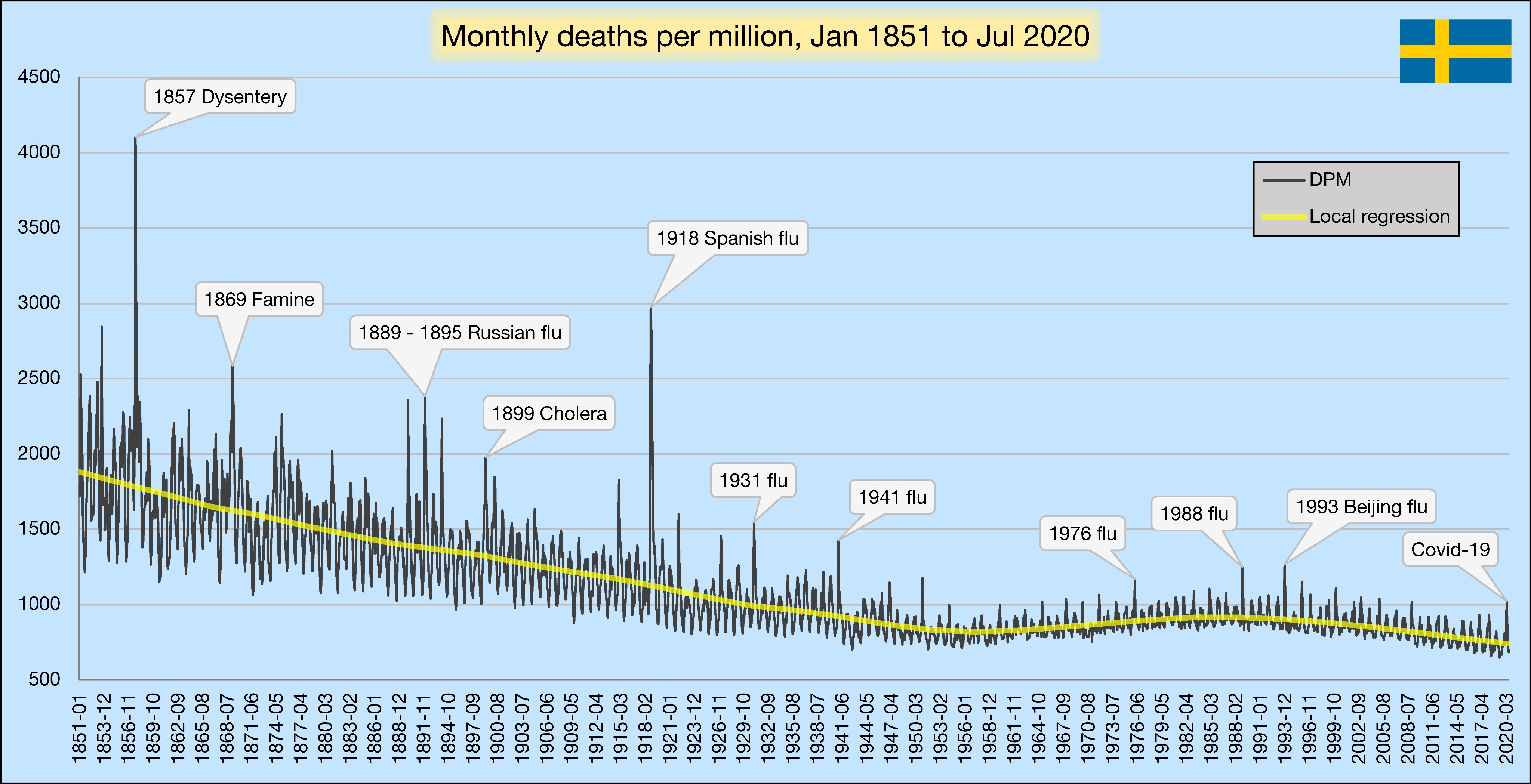
"Only" 6 5 higher mortality is huge excess mortality.
(In reality, in Sweden mortality is about 4.5 % higher than the average of 2015-2019, but that is still very significant; and of course, covid is not just that one either dies or is fine; there is the substantial but currently not very well known number of people with long-term health impact from the infection)
We already place a human value on life in healthcare, via QALY (Quality Adjusted Life Years)
This is typically about $50,000/year in places like the UK.
If you run this same calculation against what we have done for COVID, the figure comes to tens of millions of dollars per life year.
The same sums spent on lockdown and lockdown compensation could have been invested in general healthcare, or tackling air pollution (which kills 800,000 Europeans a year).
COVID lockdowns should not be immune from the cost-benefit calculations that all other Government programmes are subject to. Its also totally reasonable to ask why we tolerate influenza, which is a leading cause of deaths and fills hospitals each season, but not COVID.
> We already place a human value on life in healthcare, via QALY (Quality Adjusted Life Years)
That calculation is profoundly flawed and is based on linearity: some of the most expensive treatments are extortionate, relative to the true and actual cost to produce, against the QALY/DALY calculation. Instead, if a pharmaceutical company or a medical device company charges an extortionate amount of money for a product, the patents should be seized and governments should be allowed to produce them themselves. In a lot of cases, government funding does 80-90%+ of the research and work that allows the medical product to be marketed.
In the case of coronavirus, some governments, such as the United States, had the capability, at least theoretically to at least try and pursue the elimination strategy. That is, if the United States did not have a neoliberal government in place at the time and the citizens of the United States actually trusted its public officials. A lot of smaller countries have fared well during the pandemic. It is clear that the elimination strategy has been quite successful from an economic standpoint, for the countries that have pursued it.
> The same sums spent on lockdown and lockdown compensation could have been invested in general healthcare, or tackling air pollution (which kills 800,000 Europeans a year).
As for this matter, health insurance (private/public/national) should absolutely cover PAPRs (powered air purifying respirators) for people who are immunocompromised, have lung issues, have severe heart issues, or are at high risk from dying from illnesses like influenza. There are now half-mask (non-helmet and/or not full facemask) PAPRs that are more discreet and wearable, that are much more pragmatic than typical masks: https://industrial.optrel.com/en/product-selector-1/swiss-ai...
It is crucial that we first and foremost protect our most vulnerable, out of the principle of solidarity.
Obviously some of those deaths are directly from global warming. We have not done enough with respect to global warming, and people will die. But, this is unacceptable and we knew that it was coming. We have to do more, and putting a dollar amount on the lives of the most vulnerable is a distraction that keeps us from doing better as a society. We all pay a price by doing this.
Actually the actions work out at about $50k per qaly in US. We spent $5tn to save 1m lives Who each had about 20 years left to live. That would be $250k per qaly but hopefully not all of the $5tn was wasted/spend on additional health care costs, lot of it was to build roads and bail out mafia run multi employer pension systems in US which would have happened anyway
It's not about the "oh it's worth the risk compared to COVID 19". If it's a side effect it wasn't spotted in the trials, why was that?
It's not a side effect? It was a problem in production? What problem? Was is tampered with or was an accident? What failed in QA to let that batch come to the public? Was is a storage problem that compromised the batch quality? Was it while in transport or in the local hospital?
You talk about this like background noise. It's not. It should be investigated.
It's good that this is happening, because it shows regulators are doing their job. This is what builds trust in vaccines, not disregarding odd occurrences because they seem to have no "statistical relevance". That's just ignorance talking.
And those last couple of sentences are really, really important: If forging ahead despite the blood clotting causes folks to lose trust in vaccines, it could be worse than Covid has. And realistically, we don't need more folks to be anti-vaccine.
Exactly. This subject can easily backfire and blow the trust of a population on vaccines, or worst, on the regulators.
Imagine this is the outcome of a production problem, yet regulators refused to acknowledge this until it was out of proportions because the problem wasn't fixed. Not only people would lose trust on vaccines, they would lose trust on the regulator - this extends far beyond this vaccine, but all vaccines and medicines.
People need to feel safe, and to know that regulators are not sleeping on their job. It's not a bureaucratic job, but that they are actively looking at data and reports from doctors.
I think a lot of people (myself included) are more than willing to take a vaccine with these risks. As long as there is informed consent, what’s the problem?
Banning everyone from getting this vaccine is typical bureaucratic ass-covering. Their incentives are not aligned with ours. They get in trouble if they’re directly responsible for a few deaths, but not if they’re indirectly responsible for hundreds of thousands of deaths.
To give a point of comparison: 250 miles of driving gives you a one in a million chance of death. This vaccine is safer than that.
The problem is that it's starting to look more and more like a production problem and a bad batch, and you shouldn't be vaccinated with a product that probably should have failed QA.
It's not bureaucratic ass-covering, it's literally the protocol that's in place and has worked to keep populations safe.
>250 miles of driving gives you a one in a million chance of death. This vaccine is safer than that.
Again you're missing the point. The correct analogy would be: driving on a car that randomly combusts, or has faulty breaks, due to bad QA. And this actually happens/happened, that's why some cars are pulled from the market to be fixed when such things happen. Doesn't matter if it has happened on 1 or 2 cars, it shouldn't happen. Want another analogy?
Want another example? The Boing 737 Max.
You should only be allowed to use products that are working as expected, not faulty products. Specially not medicines and vaccines, that could blow up the trust on regulators and the vaccines.
The alternative to a car with bad brakes or a plane with design flaws is another car or another plane. The alternative to a covid vaccine is that you get covid. Even for young and healthy people, that can mean debilitating long-term illness.
There is no safe option here. We have to think like we are in war time, not peace time. Allowing people with informed consent to take this vaccine will save far more lives than banning everyone from taking it.
>The alternative to a covid vaccine is that you get covid. Even for young and healthy people, that can mean debilitating long-term illness.
Well that's arguable, I haven't had covid yet, and I don't plan on getting it. You had plenty of countries that handled covid without vaccines - we are where we are because western governments refused to take specific measures to control de pandemic (but this is another subject). So the alternative would be get a different vaccine.
Neither me EMA, or any regulator are advocating for not being vaccinated, I don't get where you're getting that from. The alternative to this vaccine is other vaccines, in EU alone 4 vaccines are approved and more are to come. Even AZ vaccine isn't excluded what so ever - they are investigating the potential cause.
>Allowing people with informed consent to take this vaccine will save far more lives than banning everyone from taking it.
Thankfully we have regulators that prevent such behavior. If there's a QA issue no one should be vaccinated with the batches affected by that, because proper QA seem to be without any of this reactions.
No one is saying side effects should not be investigated. The question is whether the vaccine administration should be halted in the meantime, and that would be determined by the risk/reward of preventing covid deaths.
Just like I trust the regulators for vaccine approval, I trust them in the decision of stopping the administration of a vaccine to further investigate the problem. This goes together.
It's not a political decision no matter how many people try to spin this. This is the outcome of doctors reporting an anomaly to a regulator. The system is working, and this should give you reassurance, not doubt about the consequences of stopping a vaccine.
I'm pretty sure they know the consequences of this setback, so for them to stop it it's because something is not right.
From the perspective of the regulators, there are asymmetric personal consequences.
If they make a decision that leads to 50 clotting deaths but saves 5000 people from COVID as a counterfactual, their head is on a chopping block because those 5000 foregone deaths are invisible but the 50 deaths are visible.
If they make a decision to halt the vaccine distribution and this kills an extra 5000 people - well that's no problem because they were just being careful.
Society has set up a political situation where there is literally only one choice that absolves the bureaucrats from a negative personal outcome. Of course they're going to go that route.
Personal incentives are incredibly powerful drivers of behavior, whatever the publicly stated reasons for an action may happen to be.
It may be the case that they've made the right decision, but we can't assume that it was for the right reasons.
You could use the same arguments and mindset when you're an antivaxx.
Vaccines can't be a holy cow that gets defended no matter what. It's always interesting that people who claim to not trust big business big pharma somehow defend everything vaccine related to death. Regulators halted it snd wait for new information to come in, that is how it's supposed to be.
Perhaps individuals should have a say as to which risk is preferable to them. As it is, the antivaxxer gets to choose not get vaccinated, but the provaxxer must wait for someone elses approval.
I'm not necessarily disagreeing with the decision, I don't know enough about the clotting data to do so, and I can certainly see the necessity in preserving the public's faith in vaccines.
I'm more saying that the incentives of regulators/politicians aren't always aligned with public health, since the decision that protects public health and the decision that protects careers aren't always the same thing.
Then it's not political reasons, it's simply self interest.
I like to believe that these institutions - regulators - know better then to cover their asses, because if that was protocol until now for sure there would be a lot of problems with medicines and vaccines.
At leas the European ones (the cases I know) seem to have been pretty competent on their jobs, so I doubt that is a motivation.
> we can't assume that it was for the right reasons
But what are “the right reasons”? This one is a moral dilemma that has no solution. “OK, let’s kill these 50 people so that that those 5000 could live.” No one in their right mind can propose that.
Overall the number of blood clots observed is actually less than expected, with an incidence lower than in the general population (i.e. without vaccine at all). My source is BBC News this evening.
On the contrary, I'm just repeating the published data and opinions of experts and indeed health agencies from the WHO to the EMA (European Medical Agency).
I think it is therefore those who are calling for who have suspended this vaccine to explain the reasons because they seem to baffle everyone.
Bearing in mind the previous 'doubts' some in the EU had about the vaccine's effectiveness for people above 65 I am not convinced that this 'cautionary approach' is all in good faith... And the head of Italy's medicine authority has just said that this was politically motivated...
What published data are you referring to? Because the event that's causing this is in no way within the statistical references most of the British media is pumping out - which is what you're talking about when you say "blood cloths".
It's not "just blood cloths", it's the type of cloths, where they are located, with low pallet count, with more incidence on a younger age group, localized in an hospital staff.
The European Union medicines regulator has reiterated there is "no indication" that the Oxford-AstraZeneca Covid jab causes blood clots, after several countries paused their rollouts.
European Medicines Agency (EMA) head Emer Cooke said she remained "firmly convinced" that the benefits of the vaccine outweighed any risks.
But even if the blood clots observed are in fact due to the vaccine the numbers are so small that it seems to me irresponsible to suspend vaccination and to publicise this so much.
Cornelius Vanderbilt [1] mastered steam powered shipping before tackling rail. An operator of technical machinery more than a trained engineer but relatively very technical for the 2nd Industrial Age IMO.
Software is eating the world but you are discounting the possibility that this force is simply drawing in the best and brightest; part sorting hat and part black hole pulling in the biggest stars.
My naive interpretation - The canonical Apache Arrow implementation is written in C++ with multiple language bindings like PyArrow. The Rust bindings for Apache Arrow re-implemented the Arrow specification so it can be used as a pure Rust implementation. Andy Grove [1] built two projects on top of Rust-Arrow: 1. DataFusion, a query engine for Arrow that can optimize SQL-like JOIN and GROUP BY queries, and 2. Ballista, clustered DataFusion-like queries (vs. Dask and Spark). DataFusion was integrated into the Apache Arrow Rust project.
Ritchie Vink has introduced Polars that also builds upon Rust-Arrow. It offers an Eager API that is an alternative to PyArrow and a Lazy API that is a query engine and optimizer like DataFusion. The linked benchmark is focused on JOIN and GROUP BY queries on large datasets executed on a server/workstation-class machine (125 GB memory). This seems like a specialized use case that pushes the limits of a single developer machine and overlaps with the use case for a dedicated column store (like Redshift) or a distributed batch processing system like Spark/MapReduce.
Why Polars over DataFusion? Why Python bindings to Rust-Arrow rather than canonical PyArrow/C++? Is there something wrong with PyArrow?
Polars is not an alternative to PyArrow. Polars merely uses arrow as its in-memory representation of data. Similar to how pandas uses numpy.
Arrow provides the efficient data structures and some compute kernels, like a SUM, a FILTER, a MAX etc. Arrow is not a query engine. Polars is a DataFrame library on top of arrow that has implemented efficient algorithms for JOINS, GROUPBY, PIVOTs, MELTs, QUERY OPTIMIZATION, etc. (the things you expect from a DF lib).
Polars could be best described as an in-memory DataFrame library with a query optimizer.
Because it uses Rust Arrow, it can easily swap pointers around to pyarrow and get zero-copy data interop.
DataFusion is another query engine on top of arrow. They both use arrow as lower level memory layout, but both have a different implementation of their query engine and their API. I would say that DataFusion is more focused on a Query Engine and Polars is more focused an a DataFrame lib, but this is subjective.
Maybe its like comparing Rust Tokio vs Rust async-std. Just different implementations striving the same goal. (Only Polars and DataFusion can easily be mixed as they use the same memory structures).
Pandas supports JOIN and GROUP BY operators so you are saying that there is a gap between Apache Arrow and other mature dataframe libraries? If there is a gap, is there no plan to fix it in the standard Arrow API?
I understand the case for a SQL-like DSL and an optimizer for distributed queries (in-memory column stores, not so much). I'm trying to understand the value add of Polars. I don't mean to come across as critical; perhaps DataFusion is a poor implementation and you are being too polite to say so.
I also think that there is a C++/Arrow vs Rust/Arrow decision that has to be made. I associate PyArrow with the C++/Arrow library. Is Polars' Eager API a superset of the PyArrow API with the addition of JOIN/GROUPBY/other operators?
There is definitely a gap, and I don't think that Arrow tries to fill that. But I don't think that its wrong to have multiple implementations doing the same thing right? We have PostgresQL vs MySQL, both seem valid choices to me.
A SQL like query engine has its place. An in memory DataFrame also has its place. I think the wide-spread use of pandas proves that. I only think we can do that more efficient.
With regard to C++ vs Rust arrow. The memory underneath is the same, so having an implementation in both languages only helps more widespread adoption IMO.
Thank you for your work! I've decided to kick the tires after reading your Python book, I think you understimate the clarity of the API you have exposed which, honestly, looks a fair bit more sane than the tangled web that pandas is.


He was a brilliant innovator that added value to the world. He was a failed entrepreneur that did not recapture part of the value he created. That makes him a huge success in my books but I wish he was more comfortable and content in his final years.